Showing posts with label Seafarers: won by Sue. Show all posts

Saturday, 20 November 2010

Seafarers (fog island) - a longer game than necessary

Since I've stopped writing about every game of Settlers that we play, I've also stopped taking photos, in general, during the games. On Thursday, Richard and I decided to play a round of Seafarers of Catan with our favourite 'fog island' scenario. I didn't want anything too lengthy or mentally tiring, although I'd forgotten just how long it takes to set the game up!

It wasn't a very equal game, since Richard made a mistake on his initial setup, and I was able to build a great deal faster than he was. When I put my final settlement down, I realised - since I had the longest trade-route, and also a couple of hidden victory points, that I'd won since I had more than 16 points (which is what we play to when there are just two of us). Richard knew it too, but suggested another couple of rounds, out of interest. All I could do, basically, was buy development cards (which I did) and I also built my last two streets and ships, because I had the cards in my hand.

And then he said I should really take photos and write about the game...

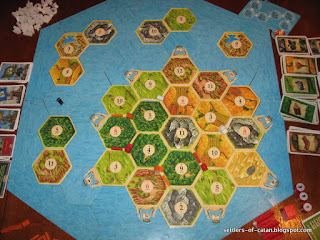
By the time we finally finished (when the last hidden hex had been revealed) the table was looking quite a mess:


Although I won, Richard took and held onto the 'largest army' card. He had one of the biggest 'armies' I can remember seeing in a game:


However, I had an extremely long trade route, giving me the 'longest street' card without even having to count:


My 'army' consisted of four knights, and by the end I had three victory points (so I had a total of 18 points) - and several more development cards which I had bought but had not had a chance to play:


It wasn't until late in the game that Richard noticed that we'd taken the wrong bonus cards - I had taken the largest army and he had taken the longest street! Not that it mattered in the slighest, as each is worth two points, but we solemnly exchanged them so as to be correct.

I was getting tired by the end, and buying so many development cards that I just threw my resource cards on the table, leading to quite a muddle:


The game was unusual for a few reasons..

1) Despite us both regularly picking up handfuls of cards by the end, the robber was never able to steal from either of us. For once, 7s were only rolled when we had both managed to spend our resource cards, and only had a few in our hands.

2) The pirate ship was not moved at all, despite a normal number of 7s being rolled, in addition to all the knight cards shown above:


3) Although I built far more ships than I usually do (by the end I had built all my ships AND all my streets) the vast majority of hexes I 'discovered' were simply sea... and the desert:


Whereas Richard, with a very modest fleet of ships, discovered only one sea hex, while all his others were resource hexes:


It was a good game, full of laughter. It really didn't matter who won - it was inevitable that I was going to, early on, but part of the fun of this scenario is exploring the hidden hexes.

Friday, 20 August 2010

Cities and Knights WITH Seafarers of Catan

It was Tim's last night here for a while. So we decided to try something new; Cities and Knights of Catan, on a Seafarers board.

We thought about playing our usual 'Fog Island' scenario, but the instructions said that it was not advisable to play Cities and Knights on any of the scenarios with unexplored territory that had to be discovered. So we thought perhaps it would be best to use the first and simplest scenario: heading to new shores. That meant we started with a regular-sized Catan island, and a few smaller ones which we could sail to. Since we could gain extra Catan chits by doing so, quite apart from the extra Cities and Knights points, we agreed to play to 16 points. Or maybe 17...

I was first to place my settlement. I was already a little overwhelmed, wondering whether to head for ship-building resources (wood and sheep), or my usual preferences (whatever is least available, particularly ore), or Cities and Knights commodity-producing hexes (wood, sheep and ore), or even the basic Settlers clay and wood for road-building.

I decided to opt for a good selection of numbers, with resources that would - I hoped - be appropriate for all parts of the game. So I took the 5-8-9 with two wood and a sheep. I headed towards the coast and a 3:1 harbour, figuring that if all else failed I could at least head out to sea.

Tim (white) then took the slightly better numbers of 5-6-9 on wood, wheat and sheep, which I had seriously considered. Wheat, after all, is vital in Cities and Knights in order to feed the knights. And of course it's an essential element of both settlements and cities.

Richard (red) took the 5-9-10 with three resources for his settlement, and the 3-4-8 with two wood and a sheep for his city, thus ensuring some reasonable commodity cards, and six different numbers. Tim took an ore and two wheat for his city, also achieving six different numbers. So I decided that I would also go for numbers... even though it left me with an over-abundance of wood, but no access at all to either ore or wheat.

With the help of my wood and clay, and some useful trading, I managed a couple of streets and a couple of settlements without too much difficulty, Then, since I was still collecting wood and some sheep, I thought I might as well build a ship... and head for yet more wood. Richard and Tim had each managed one settlement by that time, and we had all started gaining city improvements.

It was only as the barbarian ships sailed closer and closer to Catan that we realised we had left it undefended. Tim managed to buy a knight just in time:


So nobody gained a victory point as Catan defender; Richard and I both had to demote our cities into settlements.

With the help of some trading, and some useful progress cards, I was able to build my city again, and even fortify it with some extra clay so as to allow myself more cards before the robber could strike. I also bought a knight, and activated it, so that by the next time the barbarians attacked, Catan was at least defended:


Since Tim and I each had one knight, nobody gained a victory point but we each took a progress card of our choice. Since we both like the green ones best, those are what we took.

Although Richard had started with a city on the 8-wood hex, it took him a few more turns before he was able to re-build it after the first barbarian attack. So I managed to reach the metropolis on books before he did, and thus an extra two points.

Richard also played the card that allowed him to switch any two numbers on the board (other than 2, 12, 6 or 8). He chose to switch the 5-wood (on which I had two cities) with the 11-ore (on which I also had a city, and where he was aiming to build a settlement). Unfortunately for him, he did it the turn before he could built the settlement, in anticipation. He did not know that I held a street-building card, which meant that I was able to build a settlement there instead. Suddenly I had good access to wheat, which I had been aiming for, and also to ore, which I had not expected.

By the next barbarian attack, we had two knights each:


- so each of us picked up another green card. I was in the lead by this stage. I had eleven points on the board, including my metropolis. I also had one victory point from my progress cards. I'd had the longest trade route briefly, too, but Richard took it from me when he sailed out towards the wood-clay island. So he had seven points on the board (plus one victory point from progress cards too), and Tim had seven points on the board.

By the next barbarian attack, Tim had sailed out to the gold hex, and gained the longest street card. So he now had ten points. Richard, who had no ore since I took the spot he wanted, had a hard time building cities, so was still on five points. And I was still significantly in the lead with 12 points on the board, plus my one victory point, and another since I'd taken control of the merchant to enable me to have very useful 2:1 trading on wood.


I was pondering building yet more ships, then realised that two streets joining up my road segments would give me the longest route more easily - so I did that, and by the next barbarian attack was far in the lead with 16 points. So we decided to play to 18.


Richard had six points in buildings, plus an extra chit point for building on another island. Tim had ten points, plus a chit, giving him eleven. I did wonder if he would take the longest trade route card from me - he only needed three more streets or ships to do so - which would have prolonged the game for a few more rounds.

But he didn't. And when my turn came around, I had the cards to build a settlement - at last - one one of the outlying small islands. So that gave me one extra point for the settlement, and another one for the chit that was awarded for being first to build on any of the small islands.


We did, briefly, discuss continuing to 20 points, but had made a note in Cities and Knights that it gets dull after 18 points. So I was declared the winner.

It was rather exhausting trying to think about all the different aspects of the game at the same time, but very enjoyable. And my win was at least in part due to Richard's error of judgement in switching two numbers before he had built on the ore hex.

Wednesday, 2 June 2010

Seafarers of Catan: fog island (for four)

Becky had never played Seafarers of Catan. Daniel hadn't played for ages. So we thought it about time to have a game of 'Fog Island'. And since Becky was new to it, we thought that even though only four of us were playing, we would use the 5-6 player expansion, to give us all plenty of room.

It took Richard about half an hour to get it all set up. There aren't too many different rules in Seafarers -just the building of ships for one sheep and one wood hex - and Becky's good at games, so we set up our initial settlements with ease:


We used the layout in the booklet, and I was a bit surprised that it was so difficult to get access to all the resources. I found myself without ore, which I don't like at the start of any game. However, with Fog Island one sets out to see to explore other territories, so I realised there was potential for ore that way. Becky (blue) and Richard (red) both had good access to ore; if I'd made a prediction about who would win, I would have expected it to be one of them.

Since I was a little blocked in on the main Catan island, I set out to sea as soon as I could and was very pleased to find that my first uncovered hex was a clay, and the corresponding number a 6.


I was even more pleased when the next tile was a wheat-4.

Richard also started exploring at the other end - and to his surprise, also uncovered land tiles, although without such good numbers. Daniel assured us he had shuffled the hidden hexes, so it was surprising not to have had any sea in the first half dozen.


Daniel and Becky, meanwhile, were building on the main Catan island. Becky was stymied from setting out to sea at first, because of the initial placement of the pirate which prevented her from building any ships on the surrounding edges.

Eventually the pirate was moved, and Becky started out to sea. I had done more exploring... and although Richard did uncover one sea hex, I continued finding land. Unfortunately no ore, however.

Daniel was the first to build the 'longest trade route', just with streets, but Richard soon took it from him when he started exploring.


Then Becky built more and more ships, heading out towards the gold hex in the corner, and took the longest trade route herself.

I did eventually uncover an ore hex... but unfortunately the corresponding number was 12. However I managed to get as far as the other gold hex:


At last Daniel began building ships - and uncovered another gold hex:


By this stage, Daniel - who had bought a LOT of development cards - had played three knights, and so obtained the largest army. Thus he was in the lead - just - with 10 points. Becky, who still held the longest route card, had 9, I also had 9, and Richard had 8.


Then I happened to pick up a lot of wood and clay... so extended my streets, joined up my two sections, and took the longest trade route card. I was now ahead with 12 points. We had decided to play to 14, and all still had plenty of building spots. However, I had used up all my streets which isn't something I usually do.


It really was a game of battles for the longest trade route. Richard was the next person to take it:


So onw Richard had 11 points, I had 11 points, Daniel had 11 points, and Becky had 8. We sympathised, but then she's won rather a lot lately, so we didn't feel too sorry for her.

I built my last two settlements, and had 13 points. Daniel also did some more building, and had 13 points. His 'largest army' kept growing bigger and bigger; he bought a lot of cards, but nearly all of them were knights. And since his 13 points included that card, he still had the potential for another city, whereas all I could do was buy cards. Until that point in the game, I had not bought any at all. We were a bit surprised that Daniel did not have even one victory point card amongst his large collection.

And, being Daniel - and not competitive - instead of trading for another city and winning, which he could have done at least twice (although he did have rather bad luck, losing half his cards to the robber several times) decided to buy more cards whenever he could and hope for a victory point.

The first two cards I bought were also knights.

And then, on my next turn, I bought one more...and it was a victory point:


Here, by contrast, are the cards Daniel bought in the game: thirteen of them, without a single victory point:


So, a little reluctantly, I was the winner. Daniel should have been, however.

Here's the final board, where Becky had once again gained the longest trade route card:


So I had 14 points, Daniel had 13, Becky had 10, and Richard also had 10.

I guess ore is not as important in Seafarers as it is in regular Settlers of Catan, or Cities and Knights.

Saturday, 3 April 2010

Seafarers of Catan: fog island (for two)

We thought we'd have a change yesterday evening... so we played Seafarers of Catan. We hadn't played that for the whole of March. Once again, we decided to play our favourite scenario, Fog Island. We used random setup of the main island hexes, and mostly random numbers.

As ever, we started with three settlements each. We both managed a reasonable spread of both numbers and resources:


As the game started, Richard (playing red, as usual) found himself picking up a lot of cards. As he likes boats, he soon started on a sailing and exploring expedition:


He did fairly well with the hexes he turned over. He quickly took the longest street card too, with his lengthy route. I set out to sea a few turns later, and discovered a useful sheep hex:


However, my next few explorations produced nothing more interesting than yet more sea. So I kept going until I discovered that Richard's island - so to speak - had more land at my end.


I also spotted that my 'trade route' was now longer than his, so it was my turn for the longest street card.

Richard should really have won this game. He did very well with the rolls of the dice, often picking up three or more cards per turn. Unfortunately, they weren't all very useful... and he got caught three times with a 7 being rolled, when he had collected 10 or 11 cards. Having to give up half of them was not very encouraging. Even so, he managed to build all his cities and settlements several turns before I did. He then started buying cards...

I bought a fair few development cards earlier in the game when I couldn't do anything much else - and the first three were knights. So I played them, and took the 'largest army' card.

I realised, when I played my last city that I now had 16 points... but suggested we play to 18. Richard didn't think he could take the longest route card from me, but he had played two knights, and had four or five undisclosed development cards so I thought it likely he might gain the largest army. It would then be a question of luck, if we found victory points amongst our development cards.

I suppose 16 is a more sensible number of points for this game, really. But I wanted to see just how long I could make my longest route...! Richard moved the pirate ship to stop my explorations in their tracks... however I realised that I could sail from the other side instead. So I did that, and played my last settlement:


The following turn I bought another development card...and it was a victory point. So I had 18 in all, and had won.


Richard then revealed THREE victory points in his hand - two from earlier in the game, and one from the previous round. So he had 16 points.

It was a very close game, which he should definitely have won.

Oh, and my Catan 'trade route' was 26 pieces long. I had one street rather wasted at the top of the board, and three ships remaining in my stack. I wonder if it's possible to get all 30 in one route...

Tuesday, 16 February 2010

Seafarers: Fog Island for five players

Our Settlers-playing friends arrived back after six weeks away, and a guest who also plays is in our downstairs flat. So on Sunday we arranged a game! Richard opted for Seafarers of Catan and we decided to set up Fog Island, with - for the first time - the Seafarers 5-6 person expansion. It took about 20 minutes to set up...


I really did not want to win. I was tired, and had a low-key migraine; dulled with painkillers, but sufficient to make me unable to concentrate hard. I didn't even remember my camera, so Richard had to take photos using his phone.

I was the last person to place my first settlement, so got to do two at once, but by that stage most of the good spots were gone. Not that any of them were obviously brilliant. Setting up according to the booklet meant the board was fairly balanced.


I suppose I was lucky. In the early part of the game I was able to buy quite a few cards, and also built a couple of cities fairly earl on. I set out to sea fairly soon, and quickly gained the 'longest trade route' points. Jörn (playing blue) was not so lucky; he hardly seemed to pick up any cards at all. Play in general was pretty slow. Richard (red) and Sheila (brown) also managed to sail out to do some exploring, but none of us built all that many settlements or cities.


It's interesting having another person, used to playing with different people. John (with green pieces) tends to think somewhat outside the box, and will also sometimes play more aggressively. In this game, realising that I was some way in the lead, he started sailing ships out towards me - not intending to explore, or even build anything useful, but in the hope of placing a settlement in the middle of my 'longest trade route', thus reducing it significantly and meaning the card would pass to Richard or Sheila.


I managed to foil that one, once I realised what he was doing, by building a settlement there myself - although it wasn't a spot I would have chosen. John then moved his ships to a different point in my 'route', and I started building streets at the other end to ensure it stayed the longest.

I had the 'largest army' card at one point too, but Richard was able to take it from me when I had 11 points, putting me back at 9.

It's possible that Richard or Sheila might have been able to take the longest route from me, even so. And since I really didn't want to win, I wouldn't have minded... except that, by that point, it was 11pm. We'd been playing for nearly two and a half hours and it wasn't just me who was yawning and feeling bleary-eyed. So I put all my effort into building, and was able to get a last settlement, taking me to 9 points in buildings, 2 for the longest trade route, and one extra Victory Point card.


It wasn't a very even game - Sheila was the only other person who managed to build even one city. She came second with 8 points (including one card); Richard had 7 (including the largest army); John had 5, and Jörn had 4. I'm not quite sure why it was so uneven - none of the starting places were that bad. I suppose it was just the roll of the dice.

Friday, 5 February 2010

Seafarers of Catan: fog Island (random numbers)

I was very tired last night, having woken for some reason at 4.30am. So we thought we'd play a game that didn't require too much brain-power but which we enjoyed. So we opted for Seafarers: Fog Island once more, using the random hex and number setup for the main island.

I went first, but really wasn't awake enough to think of strategy. So I just opted for what looked like the best intersection number-wise, and on my final two placements went for a variety of numbers and resources. I thought I should get a fair amount of wheat, with 5, 9 and 10, and planned on the wheat harbour. That was about as far as I got.


Tessie decided she would join in. We did manage to persuade her not to get on the table....


As often seems to happen in this game, Richard set out to sea to explore uncharted territory earlier than I did. I didn't get nearly as much wheat as I'd expected, but did collect rather a lot of ore. Unfortunately the ore harbour was beyond my reach. It did mean I built some cities very early in the game; in fact I'd built them all before I managed to reach the coast and start building boats.


Richard found himself - unusually - buying a lot of cards. He quickly gained the largest army - and carried on playing knights regularly. He also gained the longest street (trade route) card fairly easily with his exploring ships.

I wasn't really thinking about winning.. I just kept exploring and/or building, using whatever resources became available. However, since we were playing our standard two-player rule that the person with lower points controls the robber when a 7 is rolled, we did have to stop and count every so often. Then it occurred to me - a turn after the event - that my 'trade route' was actually longer than Richard's. It was his turn, and he'd just placed a road that made his route 11 pieces long. I realised that mine was already 11.. which meant that I should have taken the 'longest street' card, and that he would need 12 piece to overtake.

The following turn he rolled a 7. We counted points to see who was ahead. Up to that point, it had been Richard every time. But he only had 10 points on the board, whereas I had 12. He had the largest army, but I had the longest street. So I had 14 points. I hadn't realised that.... and I also held two victory point development cards. So I showed them... that gave me 16 points, and I was the winner.


Except that... it was still Richard's turn. I should have realised that when it was my turn. I shouldn't have declared it out of turn. So on his turn, he moved his leading ship to the coastline behind the main island, and built another ship... which meant he now had the longest trade route, and took the longest street card back. Now I had just my 12 on the board (plus the two victory point cards, which I hid again) while he had 10 on the board, plus for four the army and street. And a victory point card which he showed at the same time as I showed mine, giving him 15...


So he was bound to win.... I really wanted him to win, too. And I also wanted to see if I could built my final settlement on the gold hex which would give me a resource of my choice if an 11 was rolled. I don't think I've built next to a gold hex before. So I said that now neither of us had 16 points yet, we should continue playing.

I put all my energies into building further streets so as to gain the gold hex. And succeeded :-)


Having done so, I then proceeded to roll an 11 on my next move!


And then... I built yet more ships, so I was able to take back the longest street card once more. Meaning that, instead of Richard winning as expected, I won with 17 points since I now had all 13 points' worth of buildings on the board.


It was a good game, anyway.

Sunday, 31 January 2010

Seafarers of Catan: seventh scenario - Pirate Islands

We decided to try out the seventh scenario from Seafarers last night. It looked a lot more complicated than the previous ones; even the board was bigger. The robber is not used in this game, and the pirate ship moves on a set route, the number of hexes moved depending on whichever die shows the lower number for each move. The pirate ship attacks any city or settlement where it lands.

Moreover, there's no chance to explore - instead we had to build ships on a set route towards one of the pirate fortresses at the other end of the board. There's no 'longest route' card, no 'largest army'. Instead, a race to destroy the pirate fortress, as well as building cities and settlements as usual on the main island. There isn't even a variable set-up for this game.

So we followed the directions in the booklet, placed the fortresses and initial settlement as required in the booklet. They give instructions for both a three-player or four-player game; we simply ignored the other pieces and set ours up as the red and yellow shown in the booklet - fortunately in symmetric places. Then we built two settlements of our choice each, in the usual way (me, then two for Richard, then one for me) rather than three since one was already built with a ship, and took resources for the two we chose. Here's how it looked after we'd done so:


There weren't any really obvious places, so we chose as best we could. I would have liked a 6...

At the start of each turn, the pirate ship moved forward. It wasn't long before it landed on the hex next to Richard's pre-determined settlement:


The strength of the pirate is also the number on the lower of the two dice. Richard's strength was the number of his warships. That's not the regular ships... a warship is built when someone has bought a knight from the development cards, and then (on the following turn) played it. At this stage, Richard had not bought any cards so he had no warships. The pirate ship vanquished him... meaning he lost a random resource card from his hand. If he'd built any cities, he would have lost another card for each city, too. We're not sure what would happen if he didn't have any cards in his hand at that point.

I quickly realised the great importance of buying development cards, and did so whenever I could, even though it delayed some of my buildings. I picked up a couple of knights, and on subsequent turns played them, which gave me two warships. Slightly surreally, a warship is shown by turning a regular ship on its side:


I kept buying ships and cards, as well as gradually expanding. It was odd: at first Richard was picking up a lot more cards than I was (his 6 on wheat helped) but he didn't seem able to do much with them. Then for some reason his settlement was attacked by the pirate ship WAY more than mine was, meaning that he lost quite a few cards since he managed very few warships.

After a while, I built my ships as far as the pirate fortress:


I had five warships, so decided to attack. The way to do that is to roll one die. That determines the strength of the pirate fortress. Mine is, again, determined by my number of warships. I was lucky: each time I rolled a number less than five, which meant that I removed one of the three 'chits' that was underneath the fortress. So after three turns, I'd defeated the pirates, which gave me that settlement.

If the pirate fortress had been stronger, I would have lost my two closest ships.

The winner, according to the booklet, is whoever has defeated the pirate fortress and has at least 10 points. We decided to make it 12 points (since I already had 10 by that stage) so we played a few more rounds before I finally won:


I was quite a long way ahead. Richard only had 6 points as he'd only been able to build one city.

Unusually (for me) six of the seven cards I bought were knights:


Very useful in this particular game!

Catan: Explorers and Pirates (first game, scenario 1)

Our usual default Catan game is Cities and Knights. It was quite a steep learning curve before we could relax into it, but now we can chat ...