Showing posts with label Sheila. Show all posts

Monday, 4 February 2019

Catan: Explorers and Pirates (first game, scenario 1)

Our usual default Catan game is Cities and Knights. It was quite a steep learning curve before we could relax into it, but now we can chat while playing; and do so at least once per week. Nothing spectacular has happened, so I haven't written about every game as I did at first. Indeed, I haven't written anything here for some years.

At Christmas we were given 'Explorers and Pirates', touted as the expansion to beat all other expansions.

Catan: Explorers and Pirates box


It looked complicated - we spent probably an hour just pushing the cardboard hexes and other pieces out of their slots and sorting them into the provided bags. We started to read the instructions but got rather bogged down and decided we were too tired to try it out on Christmas Day.

It was almost six weeks later that we took it out again, determined to try the first scenario. I read aloud while the other players put the board together.  We had to use fourteen ordinary hexes from our regular Settlers game, plus most of the numbers and the outside frame pieces.  But there was no robber, no development cards, not even a 'longest street' card.

We pulled out the bag of pieces labelled 'Standard':


It's really very well designed, each bag having a labelled board showing exactly which pieces should be in it. In this bag we found terrain hexes (with green stars or orange moons on the back), and number tokens, which we had already put in an old film canister.

We also needed to use some extra sea frame pieces, plus the bag of 'gold' circles:

Gold pieces from Catan: Explorers and Pirates

From our previously-sorted wooden pieces from 'Explorers and Pirates' the instructions directed us to use the 'harbours' and 'ships' and also the 'settlers'. 

Catan: Explorers and Pirates harbour

A harbour, we learned, functions a bit like a city in that it provides two victory points. But only one of each resource is gained when rolling a number adjacent to a harbour. It takes two ore and two wheat resources to upgrade a settlement to a harbour, and - importantly, but logically - it can only be built on an intersection point with sea.

Catan: Explorers and Pirates Ship


The ships, as in the Seafarers expansion, cost one sheep (pasture) resource, and one wood (lumber).  However they don't function quite like the Seafarers ships. There are only three of them per person, and they can move, up to four sea routes (intersections), at the end of a turn. In addition, they can transport the settlers pieces (and others, in future expansions, but only the settlers were used in this game). 

Catan: Explorers and Pirates Settler Ship

Each settlers piece, like a settlement, can be bought with one each of wood, clay (brick), wheat and sheep.

Just reading the instructions, and setting out the basic board took us about forty-five minutes, although no doubt this will speed up for future games.


We each started with one settlement, one harbour and one road for each of them, much like a normal Settlers game. But we didn't place them ourselves: we followed the instructions for the beginning game, and put them where we were told to, on a board laid out exactly like the one in the instruction leaflet.

Like the 'Fog Island' scenarios in 'Seafarers', ships can 'explore' the upside down hexes, and discover either resources or more sea. For standard hexes, a number is placed and a resource of that kind added to the player's hand (as in Seafarers). But if a sea hex is discovered, the player gains two gold coins; coins can be exchanged for a resource of the player's choice, but not immediately since exploring ends the turn.

Only one hex can be 'explored' per ship per turn, and there are rules about not building roads or settlements next to sea tiles, so exploring cannot happen using anything other than a ship. When a ship is carrying a settler tile, and arrives at a suitable intersection (ie with no undiscovered hexes) the ship and settlement can be removed and replaced with a standard settlement on that spot, at no further cost.


It didn't take longer to explore, and with two separate islands there was plenty of scope for doing so. Further settlements can be built in the same way, by buying another ship and settler (the ship must be at a harbour if a settler is to be bought) or by building streets and settlements as in the normal game.

There are a few extra rules too: there is no robber, but if a seven is rolled any players with more than seven cards still lose half of them. If a number is rolled (other than seven) then any player who does not receive resources is given a gold coin instead. Players can trade with each other as normal, including for gold coins, but if they want to trade with the bank the standard is three of any resource - as if everyone has a 3:1 harbour/port. There are no trading ports in this game.

We were told to play to eight points, but were close to that after only about half an hour of playing. And since we had started according to the instructions, presumably with as even starting positions as possible, we all reached seven points in the same round. So we decided to keep playing until ten points; we usually play to two points more than the official number.

But it remained even, and when Sheila (playing white) reached ten points, Richard (red) and I (orange) had each gained nine points, and both knew that we could have won on our turns. 

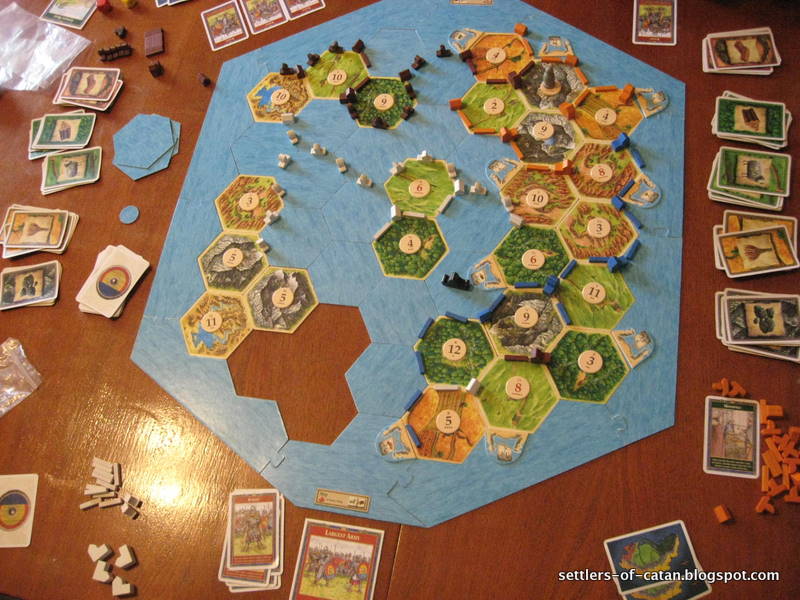
Catan: Explorers and Pirates final board

Our immediate response was that we liked it, and could see that it could form the basis of some interesting games. There are three main scenarios to be played, which no doubt we will try out over the next few months. But it was good to establish the basic rules before moving on to far more complicated scenarios.

Tuesday, 14 July 2015

Cities and Knights with Fog Island

We play 'Cities and Knights' about once a week, usually, with the occasional basic Settlers game. But a week or so back we had played Cities and Knights on Saturday evening, and wanted something slightly different on Sunday afternoon. Alternative games were rejected, and someone suggested trying Cities and Knights with one of the Seafarers games.

The only previous time we played Cities and Knights with Seafarers was five years ago, and it was just three of us. Checking that post, I see we had read that it was a bad idea to combine the former with any of the 'hidden tile' games. We didn't remember that, however, so the largest board I can remember seeing was set up, combining the 'Fog Island' scenario with the extra cards and pieces necessary for Cities and Knights.

I didn't think of taking a photo until after we had started. We followed the layout in our instructions, including the distribution of resource hexes and numbers, and I started. It wasn't difficult to choose my opening placement: the ideal spot for both Seafarers and Cities and Knights was on sheep, wood and wheat with good numbers for them all, not far from a coastline.

It was quite crowded by the time five of us had placed our initial settlements and then - in reverse order, of course - cities, and this shows the board after the first round, where both Tim (white) and I (orange) had built a street and a settlement, and I'd also managed a knight; but nothing much else had happened:


We always play our first few rounds with 'friendly robber' (and pirate) enabled: we don't roll the extra Cities and Knights die that might advance the attack towards Catan, and if a 7 is rolled, the player rolls again. This way, resources are collected in a reasonable way at the start of the game and nobody risks losing half their cards. We continue this for at least two full rounds, or longer if several people have still not built anything.

We're familiar enough now with the complexities of Cities and Knights that we could easily weigh up the various possibilities in each turn.

I took my second photo after we'd been playing for about an hour:


The scores were fairly even at this stage. Tim had ten points, including the 'coins' metropolis. Sheila (brown) had nine, including the 'cloth' metropolis and the merchant (or perhaps ten; I forget, now, who had victory points from the progress cards and from defending Catan). I had twelve including the 'longest route' (streets and/or ships). Jörn (blue) had eight or nine, including victory points; Richard (red) had six but was enjoying building ships.

Only three of us managed to build ships at all; Tim realised that he was boxed in from the start, so concentrated on building on the main island. Jörn hoped to build some ships, but was unlucky with numbers, and never managed to do so. Sheila built a couple of ships, but only 'discovered' water. Richard and I were more successful, although very few of the 'island' pieces were discovered by the time the game came to an end.

I won a round later, although I forgot to take a final photo. But it wasn't much different; I built a settlement on the spot that was available, and also upgraded to a new city. I hadn't won a game for a while, and was quite surprised to find that I had done so, although it often seems to me that, when I'm first to place a settlement, I am most likely to win.

Putting everything away was a bit complex as we had used pieces from three different boxes, but Sheila's very good at that, and we all agreed that it was a good game. We should try this more often as a variation. 

Thursday, 22 December 2011

A most efficient layout on a six-person Catan game

A few weeks ago, we were playing a six-person Settlers of Catan game, with our usual friends and one friend's parents. A six-player game can, of course, lead to rather an over-crowded board, but as we progressed through the game, it seemed that nobody had run out of building spots early on.

It wasn't until about half-way through that I suddenly realised what a remarkably efficient layout we had managed to produce:


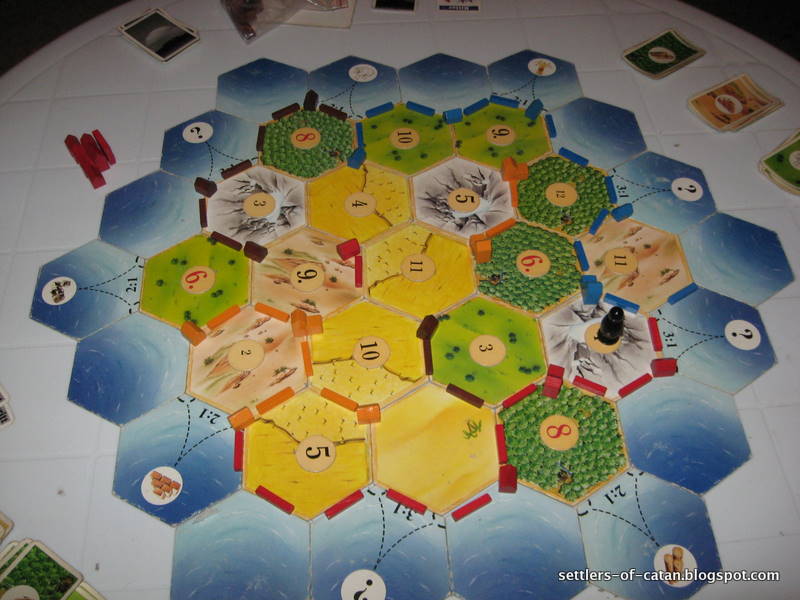
Quite by accident, none of our settlements was directly opposite another on any hex. So, theoretically, we had the maximum possible number of building spots. Blue, green and orange had all run out of new spots by this stage, but each had managed six. Red had six already, and one more. And there were four remaining spots which could be accessed by either white or brown.

As it happened, the game did not continue for many more rounds after that. Here's the final board:


I think it was Richard (red) who won, with the largest army (or perhaps two victory points) as well as ten points on the board.

Thursday, 23 September 2010

Settlers of Catan for six

It was Marie's birthday; she requested a game of Settlers after dinner. Richard was away, but Annika was visiting, and knows the game. Jacob stayed up too, so there were six of us. Annika took the red pieces; the rest of us had our usual ones (blue for Jörn, brown for Sheila, white for Marie, green for Jacob, and orange for me).

Jörn rolled to go first, and took the obvious spot from the clay-wood perspective. Good numbers for both (8 on clay), and a useful ten on sheep. Jacob was second; remembering that ore is important, he took another nice triple with ore, sheep and clay including a six.

At that point, the two remaining spots with particularly good number selections did not have three resources on them. There was either clay with two wheat, or wood with two ore. I was pretty sure that Sheila would take one of them - which she did - so I took the other. On balance I'd prefer ore to wheat, and could see that the ore harbour was not too far away, so I slightly preferred that place anyway even though Sheila's numbers were significantly better.

Annika was next, and Marie was last; two enviable positions, usually, but by this stage there really were not many useful spots next. Annika opted for ore and two clay, and her other settlement on wheat and two sheep. This gave her a 6 and an 8, but no access to wood - and it looked as if wood was going to be a fairly scarce resource anyway. She pointed her first streets inland, however, which seemed as if it might limit her potential building spots.

Marie managed two settlements that gave her - in theory - access to all five resources, but her numbers were not very good for either wood or clay. I'm not sure what else she could have done, though.

My turn again, and there was no way I could get everything I needed - clay, wheat and sheep - with one settlement. So, as usual, I decided to miss out on sheep. Not too big a deal since the spot I chose, with good access to clay and wheat, lead directly to an 8-sheep hex which I planned to occupy as soon as possible.

Sheila decided she'd take the hex that gave her access to all the three resources she needed, even though it only included a 2 on wood. Then Jacob opted for a coastal intersection that gave him wheat and wood, exactly what he needed. Unfortunately it meant that he and Marie were both heading directly for the same spot, on the wheat harbour. Jörn placed his last settlement on a spot that gave him good wheat, more sheep, and a 12 on ore.


It all seemed fairly even at this stage; nobody had overwhelmingly better spots than anyone else, although the least useful were probably Marie's and Annika's - not through bad strategy, but lack of available spaces.

So we got going, reasonably slowly at first. I was able to get the spot on the 8-sheep without any problem, and then built out to a spot that gave me an 11 on wood - not particularly useful, but I thought I might also go for the ore harbour nearby.

At the same time, Jörn built a couple of settlements too, and Sheila managed three. Jacob managed to get the wheat harbour spot before Marie reached it, which was a pity since Marie had very few possible building spots remaining. Then Jacob was first to build a city. Marie played a monopoly on wheat which gave her quite a few cards, enabling her to build a city too, although we had recommended that she grab her last easy building spot first...


So Sheila had five points at this stage in the game; Jacob, Jörn and I each had four; Marie had three, and Annika had two.

I managed another settlement, taking another spot on the 5-ore. It probably wasn't the best strategy; I was collecting quite a bit of clay, since 9s were rolled regularly, and I could have gone for the clay harbour which would have been rather useful. Sheila built a city and another street.. then Jacob had a street-building frenzy, and took the longest street card:


So now Sheila and Jacob were jointly in the lead with six points each, and I was just behind with five.

I now had to build a city before I could expand any further, and it was surprisingly difficult. 4s and 5s were not rolled very often, and since I kept picking up other cards, I had to buy development cards so as not to exceed the limit of seven in my hand, not wishing to be vulnerable to the robber. The first one was a victory point; the others were knights. Unfortunately, of course, buying them used up some of my available ore. But eventually I managed a city.

Sheila could easily have taken Marie's last building spot, but had plenty of other places along the coast. So she expanded around there, taking the longest street card, and also taking a spot Jörn had hoped for. He - like most of us - lacked wood for much of the game, which seriously limited his expansion potential.

At last Marie managed to build in the centre of the three wood hexes. She did, in theory, have one more building spot but it was likely that Annika would get there first.


So now Sheila was decidedly in the lead, with nine points, including the longest street. I had six (well, seven including my victory point, but that was hidden); Jörn and Jacob each had five; Marie had four, and Annika still had only two. She was not being at all lucky with the rolls of the dice.

However, Annika had bought a few development cards, and had played a couple of knights. She played her third, and thus received the largest army card (and two extra points). She also, at last, managed another settlement, and then fairly quickly upgraded it to a city. I took the clay harbour, although it was too late in the game to be much use. Jörn built some cities...

But it was Sheila who raced ahead of us all. She actually reached 12 points on the board on the 'building phase' of Jacob's turn, including having the longest street card. But the rules state that one can only win on one's own turn. Jacob could, temporarily, have taken the longest street card back since he had a street in his hand, and a street-building card. But he decided not to, realising he couldn't keep the longest street, and hoping for other opportunities to expand elsewhere.

As it happened, it wouldn't have made any difference. Sheila took her turn, and during it managed another settlement, and also picked up a victory point development card. So she creamed us all, with 14 points. Jörn and I were in joint second place, with eight points each...

Sunday, 19 September 2010

Settlers of Catan for four

Another Thursday evening. Another game with the four of us. Sheila brown, Jörn blue, Richard red, me orange.

It wasn't a particularly inspiring layout for the board. It looked as though there was going to be an over-abundance of wood, a fair amount of sheep, and not a whole lot of anything else. Nor where there any obviously brilliant starting spots.

Sheila went first and took the 3-6-9 with ore, sheep and clay. It's where I'd have gone in first place, too. Probably the best place for numbers, certainly the best spot for clay which was likely to be the scarcest resource of all.

Jörn went second, and took the 4-8-10, with wheat, with wheat, wood and sheep. Equally good numbers, technically, but no clay or ore. I was third. Already there were no attractive spaces to take, so I followed the strategy of taking the best possible ore spot, which was on a 5. It bordered a 6-wood which I hoped would be useful, and also an 11-wheat, which was less likely to be of value.

Richard was last; quite a useful situation for this unhelpful board. He was able to get access to all five resources, and five different numbers: 3, 4 (twice), 8, 9 and 11. I now needed clay and sheep, but the only place to get both was on the coast, with a 2 on the clay, which didn't seem very useful. So, as I usually sacrifice sheep (so to speak!) if one resource must go, I looked at the options for clay. There was really only one possibility: the final place on the 9-clay hex, which bordered a 10-wheat that I hoped would be useful, and also the 2-clay. So that's what I took.

Jörn needed clay and ore, so he took a reasonable spot which gave him both, even though the clay was on an 11; it also gave him an 8 on wood... and made it unlikely that Richard would be able to take the nearby 3:1 harbour.

I then took a photo, not realising that Sheila hadn't placed her second settlement. She suggested I post it anyway, and ask readers where they might have placed the second brown settlement...


Sheila pondered two or three options. She needed both wheat and wood, but couldn't possibly take both. She had considered one of the 8-wood hexes, but one possible spot bordered only the desert, and the other bordered only the 3-ore hex which she had access to already; she was tempted by it, since it would have given her an instant 3:1 harbour, but it looked as if she might have been boxed in rather rapidly, with very few - if any - building spots.

So, as wood was evidently going to be plentiful, Sheila opted for the 3-10-11 intersection which gave her two wheat hexes, and five different numbers altogether.


Play started quite slowly, except that 11s were rolled more often than would be expected, and 10s not at all in the first few rounds. Jörn and Richard were both easily able to build streets, and I went as rapidly as I could to the intersection with two wheat hexes which would give me a five. Richard built in the spot where Sheila had hoped to go, which meant that her building spots were rather limited anyway, and he was first to gain the longest street card, but Jörn soon extended his street further and took it away.


So Jörn had five points, as did I; Richard had four, and Sheila had three.

With my extra wheat and reasonable ore (5s were rolled pretty much as expected statistically), I was fairly quickly able to build another city. I did have to give up cards to the robber more than once; but I found myself with wood and sheep all too often, and nothing I could do with them. It then occurred to me that I should probably take the wood harbour; I hadn't thought of it as a useful building spot, since I already had two settlements on the 2-clay hex, and one on the 5-wheat. But with the amount of wood I was collecting, it was definitely worthwhile.

So I took it - just before Richard planned to. He kept extending his street in the hope of taking back the longest street card. He did for a few rounds, but then Jörn took it back again, and we realised that he was now unbeatable as far as that went.

I then built another city, made almost entirely of 2:1 traded wood.


So Jörn had eight points at this stage, and I had nine. We each had one remaining building spot, although my last one was also Sheila's last one, and she was struggling to do anything so I didn't plan to take it, even though she urged me to! I had already played two knights - being in the lead, I was frequently the target of the robber - and needed only one more to gain the largest army. I also knew I could fairly easily build one more city, so I didn't actually need another settlement.

And that's what happened. If Jörn had had a hidden victory point card, he would have won, but he didn't. So when my turn came around, I built my last city, and played my third knight:

Monday, 13 September 2010

Seafarers of Catan (Fog Island scenario) for four

Jacob was out sailing with Richard and Mick. Marie wanted to play Seafarers... so we set up a four-person game. We played with our usual colours: brown for Sheila, blue for Jörn, white for Marie and orange for me. We decided on our favourite 'Fog Island' scenario, which is enjoyable to play but rather time-consuming to set up as it requires pieces from both the regular Settlers and the Seafarers boxes. There are hexes and numbers that show, and piles of them to be 'discovered' by building ships.

We opted for random placement of hexes in the main Catan island, but put the numbers according to the booklet.

There's never much room to set up initial settlements in this scenario; I always hope to sail out to discover further resource hexes. So I opted for the best numbers I could, in the circumstances. The only resources I started with were ore, wheat and clay.. which, I realised later, was a bit foolish in this game since it's wood and sheep that are needed to build ships!

Sheila was lacking clay, Marie was lacking ore, and Jörn was the only person with all five resources at the beginning. Marie was the only one of us who began with a ship rather than a street, and was thus in the best position to begin exploring first.


.. and, indeed, that's what happened. Sheila (lacking clay) and I (lacking wood) both managed a city before anything else. Jörn built a street and a settlement.. and Marie built ships, sailed away from Catan, and discovered a very useful 6-sheep hex:


I managed another city, then by dint of some trading was able, at last, to build a new settlement. Sheila started sailing out from Catan, and discovered a wood and a sheep hex. Exactly what I would have liked... but with neither wood nor sheep easily available to me, I didn't have much hope of building any ships. Nor, I realised, did I have anywhere to go since my coastal settlement was in between Marie's and Sheila's shipping lines... I would have to concentrate on building on Catan.

Marie was first to gain the longest street (or shipping route) card:


However, Sheila was just in the lead with six points. All the rest of us now had five.

That 'longest street' card changed hands several times in the game. However, Marie was also first to gain the largest army - she kept buying cards, and kept getting knights - and nobody got anywhere near challenging her on that.


At this stage, when Marie held the largest army and longest street card, she had seven points. So she was just in the lead: the rest of us each had six. It was a pretty even game, point-wise.

The longest route card went to Sheila, and then back to Marie, who was determined to keep it. The problem was that she used her resources on ships, and so didn't take the opportunity to build any settlements. I had eight points on the board - still just on the main Catan island - and Jörn had seven. Sheila also had eight points, including settlements on her discovered hexes. We also noticed that Jörn was gradually extending his streets, and might soon be able to take the longest street card himself...


However, it was Sheila who eventually took and kept the card. She had nine points on the board in buildings... and when her turn came around, she was able to build another settlement, and thus won the game with twelve points:


I was quite pleased to have eleven, since I hadn't built a single ship.

Settlers of Catan for five (with Mick)

Having introduced our friend Mick to Settlers of Catan, and found him rather proficient, it seemed like a good idea to play a five-person game with Jörn and Sheila a couple of evenings later.

Since Mick had only placed once, it seemed better to use our set, even though we were at our friends' house, so that he didn't have to try and understand a different set of graphics - not to mention German text on the development cards. Mick was happy to play with the green pieces again, and the rest of us took our usual colours: brown for Sheila, blue for Jörn, red for Richard, and orange for me.

Richard rolled to go first, and with plenty of nice spots to choose from, opted for the 5-6-9 intersection on ore, sheep and wheat. I was second, and since I like to have good ore I took the 4-8-9 with clay, ore and sheep. I would have done slightly better, I realised immediately, to have taken the 5-6-9 which Jörn then claimed, with exactly the same resources and slightly better numbers. Sheila went next, and took yet another good spot: 4-6-9 on sheep, clay and wheat. Then it was Mick's turn to play last and first, placing two settlements together. He chose the 4-5 coastal intersection on ore and wood himself, and we advised on various other options; he decided on the 5-8-10 with the other three resources he needed. He had good numbers, but only four different ones.

On the way back, there were still some reasonable spots to take. Sheila needed wood and ore, and found a good intersection providing both, and giving her six good numbers. Jörn and I both needed wheat and wood; so, unsurprisingly, he took the one good spot with both available. I then decided that wheat was more important than wood, so took a spot with two wheat and an ore, giving me six different numbers (one of them being a 12, so not very useful). Richard, in final place, needed wood and clay, and was able to get rather a nice spot with both, giving him also six numbers, including a 12.


So I was the only player who did not have immediate access to all five resources at the start of the game. And wood was in rather short supply, so I was unable to trade for it. Jörn, Sheila and Richard each managed a street and a settlement each in the first few rounds... and I built two cities.


So, technically, I was in the lead with four points. However, without being able to build streets, I was now rather stuck. And, indeed, it took me quite some time before I managed to build even one new street. In the meantime, everyone else had done significant amounts of expanding:


So Jörn and Richard each had five points by this stage, while the rest of us each had four. And I could see that I was going to get boxed in before long, if I didn't start expanding.

Richard was first to take the longest street card. Then, in a move I haven't seen before, Sheila - who wanted a 9-10 double wheat intersection - built in the middle of his street, thus breaking it into two sections, and meaning that nobody held a five-section street any more so it had to be returned to the bank:


Richard had been in the lead with nine points, but was now back to seven. Jörn also had seven. Sheila had six, I had six, and Mick had four.

I managed to build another city, and another settlement. My final possible building spot was on the desert, so I did build one street towards it. But realised that I would do better to buy cards at this stage; I had played a couple of knights, so when I managed my third I did gain the largest army, and another two points. I had a hidden victory point card too, and when my turn came around I bought another card. Had it been a victory point, I would have won... but it wasn't.

So Jörn, who by this stage had ten points on the board, and the longest street card, was the winner with twelve points.


Mick still had only four on the board, but he had a couple of victory point cards, so his total was six, putting him just one point behind Sheila.

Saturday, 11 September 2010

Four-person Settlers of Catan game in the evening

Looking back at the scoring lists we keep, I was a little surprised to discover that the last time Richard and I played a four-person Settlers game with just Jörn and Sheila was back in May. We've loved having so many other people to play Catan games with, of course, but sometimes it's good to have just the four of us who played so many games together last year.

We set the board up outside, for the first time this year. And, since I'm writing this four days after the game happened, I've forgotten who started. I think it may have been Jörn (with blue pieces, as usual). If so, then he opted for the six-wheat hex as one of his starting ones since wheat looked as if it might be in short supply. if he was first, Sheila was second (brown), and took one of the 8-4-3 intersections which I had been looking at. I (orange) then took the other. Richard, who (I think) was last (red) began with good numbers (5, 9, 10) - the best selection of numbers available - on wood and two clay.

It was quite a nice board, and we all managed to begin the game with a reasonable selection of resources and numbers. Richard lacked wheat by the end, while Sheila and I each had only 11 on wheat. But nobody was obviously in a much better position than anyone else:


The first few moves were fairly predictable, and also reasonably amicable. Jörn and Richard both headed towards the coast, and the relevant harbours. Richard did build an extra street to protect the wood harbour from Sheila; so she went the other way towards a 3:1. I decided to head for an inland spot first; not particularly useful in theory (3 on sheep, 11 on wheat, and the desert...) but I could see that inland spots were going to be at a premium, due to the layout of our initial settlements. I did have a faint hope that I might be able to build out quickly towards the 5-wheat/10-ore hex, but suspected that Jörn would get there first...


...which, indeed, he did. Sheila headed to the other side of that nice 5-wheat hex, so I concentrated my building around the coast near the 8-ore hex I'd taken at the start. Richard hoped to get there too, and we did compete for the spot which eventually I took - but since he'd built an extra street it was still possible for him to get a spot around the edge of that 8-ore hex.

Oddly enough, 11 was rolled rather often in this game, so it wasn't long before I was able to build my first city.


So Sheila and I each had five points, Richard had four, and Jörn had three.

I decided, next, to head towards the coast at the bottom of the board in the hope of being able to get a 9 hex. Sheila, meanwhile, gained the longest street card. Richard and Sheila each built a city, but Jörn was having a hard time getting the resources he needed, and was still stuck on three points:


So Sheila was well in the lead with eight, while Richard and I each had six.

Building spots were fast becoming scarce, but Jörn had good supplies of both ore and wheat, so was able to build some cities - and as he did so, naturally gained more frequent resources which he could trade as needed. In quite a short space of time he went from three to eight points. I managed to get my coastal hex including the 9-clay, and Richard took the sheep harbour, which I did also consider. It could have been decidedly useful. Sheila extended her longest street to ensure that nobody else could take it - not that there were really any possible contenders by this stage.

Sheila and I had each played two knight cards, but she was first to play a third and thus gain the largest army:


So she now had ten points. Jörn had jumped to second place with eight, while Richard and I each had seven.

We now concentrated on building cities and buying development cards, while hoping not to be caught by the robber with more than seven resource cards. We reached the stage where Sheila had eleven points and I had nine... and then I played a fourth knight, and took the 'largest army' card from her. So now I had eleven, and she had nine.

I had one more city to build, and although nobody would trade with me, I managed it anyway and thus scraped another win:


But it was all very close. Richard and Sheila each had ten points, and Jörn had nine.

Monday, 30 August 2010

Four-person Settlers of Catan

Richard was busy, and Jacob was away on camp... so we sat down to a four-person Settlers game late yesterday afternoon. Jörn played blue, Sheila brown, Marie white, and I was orange.

I was first to place. Ore looked as if it would be the most scarce resource, so I knew I would place on the four-ore hex. I was undecided between the 5 (sheep)-8 (clay) intersection, and the 6 (sheep)-9 (wheat). From the number perspective, they were equally good. I decided that, on balance, I preferred to have slightly better access to clay than to sheep; and clay is always useful at the start of the game. And it looked as if there would be plenty of wheat available for trading.

Jorn played second, and took the 5-9-10 with wood, wheat and sheep. Marie went next, and took the spot with the best number combination on the board: the 5-6-9 with sheep, wheat and wood. Then Sheila was both last and first. Unsurprisingly she took the spot I had seriously considered, also bordering the 4-ore hex. And she also took the coastal 8-10 with clay and wood. That gave her access to all five resources, and five good numbers: 5, 6, 8, 9 and 10.

Marie needed clay and ore, and had two possible spots: she took the 3, 10 and 11 which also gave her sheep. So she had six numbers: 3, 5, 6, 9, 10 and 11. Jörn also needed clay and ore, so he took the other appropriate spot, giving him two clay and an ore. So he also had six reasonable numbers: 3, 4, 5, 9, 10 and 11. No 6 or 8, but it was likely that he would head to the 8-wheat.

Then, at last, it was me again. I was lacking wheat and wood. My instinct was to opt for wheat rather than wood, although it would have made it rather tricky to get started. And the only good spot on a wheat hex was the 8-4 coastal wheat-clay spot,
The biggest problem with that was that I already had an 8 and a 4, so would be limiting myself to three numbers altogether.

So, with an inward sigh, I opted for the 9-10 coastal intersection with two wood. It was a bit annoying for Sheila since it stopped her from getting the nearby 3:1 harbour which she was aiming for, but the board was already looking crowded. Due to some of the initial placements, there were a surprising number of unavailable spots.

I forgot to take a photo until we'd played a couple of rounds, but all we had built by this stage were a few streets:


Since I'd taken the harbour Sheila had wanted, she built as quickly as she could out towards another 3:1 harbour, thus preventing me from going there. So I could not expand anywhere from my first settlement.

Surprisingly, ore was not in short supply since 4 was rolled rather more often than expected. But without wheat its only use to me was trading - which I did, fairly extensively. I did manage to build on the sheep harbour. Marie had hoped for that spot, but my only hope of building anything at all was to continue around the coast. I'd have liked the 6-11-12 intersection which would have given me access to wheat. Marie would also have liked it. But Jörn built out towards it - and beyond, so that it was secure to him - and took the longest street card in doing so. Then Sheila was the first to build a city:


So Jörn was in the lead with six points, although he didn't expect to keep the longest street card. Sheila had four points; Marie and I each had three. But Marie and I were already struggling to find building spots.

It wasn't long before Sheila took the longest street, and incidentally giving herself quite a few useful building spots:


Marie joined her segments of road, so that she took the longest street card temporarily, but she didn't have the potential to keep it. She aimed for her last building spot, on the desert.. and then Sheila built more streets, and took the card back again:


So Sheila was now in the lead with seven points, closely followed by Jörn with six. I had finally managed my first city, so had five points, and Marie was trailing with three.

I realised that I could, potentially, take the longest street card - and since there wasn't much else I could do, and I had the resources in my hand, I did build a couple more. But Sheila had calculated that she could reach 14 segments, which was the maximum I could reach... so she build the rest of her streets, to guarantee keeping it:


So Sheila now had ten points, but Jörn was still close behind with nine, and I had eight. Marie was still trailing with five. By this stage there were NO building spots left on the entire board... so we were all after ore, wheat and sheep, with little use for wood or clay other than for trading.

So although we were all picking up a fair number of cards, not much happened. We just bought cards, and occasionally played them. Then Jörn build another city:


- so he and Sheila were now equal with ten points each.

Then Sheila built another city.

Then Marie played a third knight card, and so gained the largest army.

And then, at last, Jörn bought another card which was a victory point. He already had one hidden one, so that gave him the twelve points he needed to win:


So he had 12 points, and Sheila had 11. I had 9, and Marie - who also had a hidden victory point card - had 8.

Thursday, 19 August 2010

Settlers of Catan for four

Our game of Seafarers of Catan was over so quickly - it was only 9pm when we finished - that we decided to play a quick game of regular Settlers as well. We kept the same pieces: red for Richard, white for Tim, brown for Sheila and orange for me.

I went first, and took the predictable 4-5-8 with clay, wood and wheat. Richard was next; he decided to go for numbers, so took 6-5-9 on sheep and two wood. Then it was Tim, who took 5-9-10 on two ore and clay. Sheila likes the last position best; she was able to take four useful numbers (3, 8, 9 and two 10s) with all resources other than sheep. Tim ended his placement with a lot of ore, no wood or sheep, and six good numbers (3, 4, 5, 6, 9 and 10). Richard lacked wheat after his second placement, and didn't have as many numbers as he would have liked (2, 5, two 6s and two 9s). And I then had nowhere to get ore - which can be a big problem. So I opted for the least bad numbers that would give me the other some sheep, and ended up with six (3, 4, 5, 6, 8 and 11).

And I forgot to take a photo at the end of our settlement placements. However, I took this one shortly afterwards when we had all built at least one street - there was no real shortage of clay and wood at the start of this game - and both Richard and Tim had built a new settlement (Richard on the ore harbour; Tim, who would really have liked the ore harbour himself, on a 3:1).


It wasn't too long before Richard took the longest street card, and shot into the lead. He had six points; Sheila and Tim each had four, and I still had three:


However, Tim and Sheila both managed to build cities. Richard (lacking wheat) could not do so, and my lack of ore made it equally difficult. So Sheila caught up with Richard:


They each had seven points, while Tim and I each had five. And due to the placement of the hexes, there were very few building spots left. Tim and I didn't have any; Sheila and Richard each had one left. But Richard and I were having a hard time building any cities. He did manage one, and I managed two... but Tim, with his plentiful ore, upgraded all four of his settlements to cities. He also bought development cards since there was nothing else for him to do... and then won the game, by playing his third knight (thus gaining the largest army) and revealing two hidden victory point cards:


He hadn't expected to win, when Richard stopped him from getting the ore harbour. If he had been able to take it, he would probably have won rather more quickly. But it was quite a decisive victory since nobody else had more than eight points.

Catan: Explorers and Pirates (first game, scenario 1)

Our usual default Catan game is Cities and Knights. It was quite a steep learning curve before we could relax into it, but now we can chat ...