Showing posts with label won by Becky. Show all posts

Tuesday, 6 July 2010

Five-player Settlers of Catan

Becky returns to the UK this week, so Sheila wanted one more Catan game while she's still here. Jörn was out last night, so that meant - for a change - a five-player game.

Sheila (brown, as usual) placed first, and took a spot with good numbers and resources. So did Becky, playing second (and confusing us a little by playing with the blue pieces). I was third. I could see that clay was likely to be in short supply in this game, so I opted for a coastal tile with clay on 6 and ore on 4. It happened to be on the ore harbour, too, which I hoped would be useful.

Richard (red) was next; he opted for the other placement on the 6-clay hex, although the other numbers weren't great, and Daniel was last, playing white. He was able to get access to all five resources, although his numbers weren't too great: 3, 6 (twice), 9 (twice), and 12.

Richard, who always likes, if possible, to have an 8 and a 6 in his initial placements, opted for the 8-10-11 for his second settlement; he had no ore, but hoped to reach the 5-ore tile soon.

There was no way I could get all three of the resources I needed, so I decided to take the best available number combination. That was the 4-6-9 on wheat, wood and ore. I thought that since I had the ore harbour, another good number on ore would be sensible. It wasn't until after I'd placed my pieces that I realised I only had three numbers: 4 (twice), 6 (twice) and 9. However I'm not sure that there was any significantly better place that I could have chosen. Becky then took a good spot giving her potential access to all five resources, and Sheila went right in the middle of three wheat hexes, which gave her probably the best numbers of all of us: 4, 5, 6, 8, 9 and 10.


Play started fairly slowly, although I was lucky in that both a 4 and a 9 were rolled in the first couple of rounds, meaning I could build a city rather quickly. I regretted not having an 8, since 8s were rolled significantly more than 6s - however, when 6 did come around, I picked up both wood and clay. When I was able to make my second city, I effectively picked up two streets any time a six was rolled.

I had hoped to aim for the 5-ore hex but realised that Richard would also do so, and block the place I hoped to build, so I set off in different directions - a safe one around the coast and towards the 3-ore hex, blocking Daniel's access as I did.

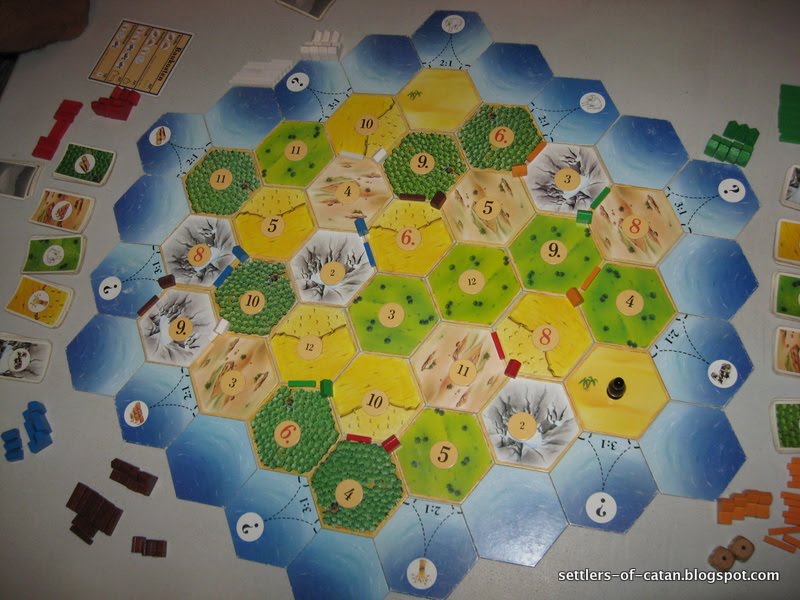
So here's the board after a few rounds. I had six points; Sheila, Becky and Richard all had five, and Daniel had four. However Daniel had been buying a lot of cards, so we expected him to take the largest army sooner or later.


In fact it was Richard who first managed to play three knight cards, and so gained the largest army. Daniel had picked up some other useful cards, however, and was able to get first access to the longest street:


So Becky had eight solid points by this stage and Richard had eight including the largest army. I had seven solid points, and Daniel had seven including the longest street. Sheila had six. It was still very evenly matched, depending very much on the roll of the dice. Some rounds I picked up nothing at all - still being rather limited for numbers, although not as much as I was at the start - and other times I picked up a couple of streets or (when a 4 was rolled) a city.

With just five of us on a 5-6 player board, there was plenty of room for expansion. I don't think anyone ran out of building spots entirely. I took this photo a few rounds later, when the situation was similar to the previous one, except that Daniel had played a fourth knight and so taken the largest army card from Richard:


That gave Daniel 9 points, despite the fact that he hadn't yet managed to build a city. Becky and I both had nine solid points on the board too. Richard and Sheila both had seven. It could still have been anybody's game.

Then Richard linked his two road sections, gaining the longest street and two more points:


Sheila, who had been watching the numbers closely, monopolised sheep. Unfortunately for her, Becky hadn't been picking up the sheep she should have taken when 8s were rolled (although she had taken her ore). Sheila should have been able to extend her street to take the longest street card..

But she couldn't. She was able to build another city, putting her on eight points and (although we didn't know it at the time) she had two hidden victory point cards. So if she had been able to take the longest street card, she would have leapt from 7 points on the board to 12 in one turn, and won the game.

Instead, Becky had another turn. She was also able to build another city, putting her on 11 points... and a hidden victory point meant that she was the winner:


It was a good game. Sheila, Richard and I all ended with ten points, and Daniel had eight.

Monday, 5 July 2010

Settlers of Catan for six (or seven) on Sunday afternoon

Another Sunday afternoon; another Settlers of Catan. We didn't start until 5pm and wanted to eat by 6.30, so I didn't think there was time for a Seafarers game as it takes so long to set up, and the games tend to be a bit more protracted.

Seven of us wanted to play, so Jacob and Daniel decided to be in a team together. An interesting combination, since Jacob is one of the most highly competitive people I have ever met, and Daniel is possibly the least competitive person I know...

Becky was playing with the red pieces, and rolled the dice to go first. Clay was evidently going to be a fairly scarce resources in this game, so she wisely opted for the intersection including the best clay hex with a couple of other resources, all on good numbers. Sheila (brown) was second, and opted for the other obviously good place, again with three great numbers and three different resources. No clay, but she did have wood.

Jörn (blue) was third, and went for three reasonable numbers, including an 8 on sheep, while evidently hoping for one of the sheep harbours. Daniel and Jacob (green) were next, and after some discussion opted for a 3-6-10 intersection. I rather fancied the nearby 4-6-10 and wasn't sure why they didn't opt for that one other than wanting wood rather than wheat. Still, it meant that I couldn't have that one. So I decided to ignore resources, and go for numbers. I took the 5-6-9 with two wood and wheat. Marie (white) was last - so she opted for two places that gave her access to all five resources, plus the ore harbour. Her clay access was only on 12 but at least she picked up one as a starting point, and hoped to build towards the 11 on clay.

I was a little surprised that the other reasonable spot on the 10-clay hex was still available; even better was that it was near the wood harbour, and I had two good wood hexes. So I took clay and two sheep as my second placement.


By the time it got back to Becky, there was still an excellent spot for her to gain the two resources she was lacking: wood on 9 and ore on 8. It was a coastal hex, but undoubtedly the one I would have taken in her shoes.

And so we got started, around 5.15pm. 8s were rolled rather a lot in the early part of the game - I had no 8s, so they were no use to me. There were quite a few 9s as well, however, and even one or two tens, so I was able to build out towards the wood harbour and build a settlement on it. Becky had ore on 8 and wheat on 9, so was quickly able to build a couple of cities. She also bought cards fairly regularly. And when she noticed that there was only one wood resource left in the stack, she played a timely monopoly on wood:


With that, she was able to build another settlement and some streets, gaining her the longest street card:


So now Becky was in the lead with seven points. Sheila and Jörn each had four points, I had three, Jacob/Daniel and Marie were still each on two.

I was pleased to be able to build on the 11-8 intersection giving me an 8 at last, on ore (the one resource I had been lacking). And then I built out again, on a useful 9-wheat and 4-sheep. With 4, 5, 6, 8, 9, 10 and 11 I now had a good range of numbers and all five resources, and hoped to start being able to build cities since I had used up my five settlements by this stage.

But Becky had played her second knight. Clearly she was also going for the largest army - and she had six points on the board as well as the longest street. Her next nearest rivals were Jörn, Sheila and me by this stage, each on five points. Marie had managed to build one settlement, but Daniel and Jacob were still stuck on two points. Two building spots they had hoped for had been taken by other people, and they weren't picking up many resource cards at all.


Becky could have won the game, by playing her third knight, since she had two carefully hidden cards which we were all sure were victory points. But she thought she'd play another monopoly card instead. She was unlucky - she asked for wheat, as there was plenty of it in the game; but at that point, nobody had any wheat. So she couldn't play her knight after all, and we knew there would be at least one more round. It seemed that the game was going to be over before it started.

I realised that, with my useful wood harbour, I could take the longest street. So when my turn came around, I built two more streets - not going anywhere, but joining up my two sections of road. So I took the card from Becky, reducing her victory points by two. Except that she had already built another city in someone else's building phase, so she had seven points on the board and was evidently going to claim the largest army when it got to her turn again.


When Becky's turn came round, she had the cards to build yet another settlement. So she had eight points on the board. She then played her third knight, giving her two more points for the largest army.


.. and, as we surmised, she also had two victory point cards:


So Becky had won with twelve points, and I was her nearest rival at seven. We finished by 6pm, so it was one of the quickest 5-6 player games we had ever played.

Sunday, 4 July 2010

Settlers of Catan: The Barbarians (from Traders and Barbarians)

Another evening in with just the four of us. Another scenario from 'Traders and Barbarians of Catan' - and the next one was entitled 'The barbarians'. A lengthy description ensued in the accompanying booklet, which made it sound rather more complicated than I liked.

Firstly, we each had six knights, in colours matching our regular pieces. At least, three of us did. Richard played red, as usual; I played orange, Becky white. But Daniel wanted to play with the brown pieces, and brown is one of the extension colours. So he used brown cities, settlements and road, and blue knights.

Here is my set of knights:


The board is set up rather differently too. No rivers or fish this time, but one extra hex that replaces one of the wood/forest hexes. It's called the 'castle' hex, and goes in one corner of the grid:


In the opposite corner goes the desert. Then the rest of the hexes are shuffled and distributed randomly... but the numbers have to be placed as shown in the booklet. This is so that there is one of each number in the outer (coastal) hexes. Those are where the invading barbarians can be placed.

Here are a few of the barbarians:

And here are the new development cards for this game, which replace the usual ones:


No monopolies or road-building; the majority are knight-placement cards, with one or two that allow knights to be moved.

So - after twenty minutes reading the rules, and setting the game up - we finally got started. Initial placement is as in regular Settlers of Catan, except that the second placement is a city rather than a settlement. As in the Cities and Knights game. That's to enable the game to get going more quickly, since buying cards is more important in this game than in others, so as to build knights to defeat invading barbarians.

We didn't really know what strategy to use for our initial placement, so basically opted for what we would choose in a regular game. Richard placed first AGAIN - it seems to be a trend at present - but as the rest of us were sitting in different places, I was second rather than last. Becky was last, and managed to get a very nice set of numbers and resources, as did Daniel. I was quite pleased with mine, too. Richard's numbers were probably the least useful.


Oh, and the last thing to do in the setup phase was to place a barbarian on each of the outer 2 and 12 hexes.

We had decided to play with dice for resource production, rather than Catan event cards, to make it as simple as possible.

It wasn't long before Becky built her first city. The buying of any settlement or city is a prompt for barbarians to appear in Catan. So after she bought it, she had to roll the dice several times. The aim is to come up with three different numbers, excluding 7 - re-rolling repeatedly, if necessary, to get the three different ones. Barbarians are then placed on the corresponding outer hexes.

She rolled 5, 8 and 9, and so we put barbarians on the relevant hexes:


Richard was the first person to buy a development card, which enabled him to place his first knight. It has to start on one of the paths surrounding the castle hex in the corner, but can then be moved up to three paths at the end of the turn. So he moved his to the 12-sheep hex where he had a city, and where the initially placed barbarian still stood:


Then Becky bought a card, and also placed a knight. And since we wanted to see how the barbarian conquering would go, she moved her knight also to the 12-sheep hex.

At the end of someone's turn, a battle occurs on any hex where there are any barbarians, if there are more knights adjoining it than barbarians on the hex. So at the end of Becky's turn, that battle took place.


If both knights had belong to the same player, that person would have captured the barbarian (worth half a victory point). Since there were knights of different colours, Richard and Becky each rolled a die, and the one who rolled higher (Richard, in this instance) took the barbarian into captivity. Becky had a compensation prize of three Catan coins.

Yes, there are also cardboard coins in this game, although Daniel found some real old coins which we used instead. Two Catan coins can be used to buy a resource card. Up to two can be bought in any turn.

After the barbarians are removed, a die has to be rolled one more time, and placed on the castle hex. A two was rolled. That means that any knights on the battleground which are on corresponding paths have to be removed too - in this case, it was Richard's knight that had to be removed from the board. However, that also gives three Catan coins in compensation.


The regular part of the game was continuing rather more slowly than usual. Becky managed to build several streets, which effectively blocked a building spot I had hoped to use, and also gave her the longest street card:


Becky and Richard both had cities adjoining the 9-wheat hex, so the next battle against a barbarians took place there:


Since there were two player involved (even though Becky had two knights), and two barbarians, they simply took one each into captivity. So now Richard had two captured barbarians, and thus an extra solid victory point.

The next battle involved three of us on the 5-wood hex. So we each had to roll a die, and the two highest took a barbarian, while the third gained Catan coins:


At first we did quite well with vanquishing the barbarians, but settlements and cities were being built fairly regularly, and each time the dice had to be rolled, to enable more barbarians to land on Catan.

And so, before long, the 9-wheat hex had three barbarians on it, and was vanquished. The number was turned upside down, and no more resources were produced by it, until such time as four knights could gather to conquer the barbarians.


The same thing happened on the other side of the board. Becky was not too happy, since each one adjoined one of her cities. She now had nowhere that would produce wheat for her:


I was so interested in taking photos of the various battles that took place that I quite forgot about taking whole-board pictures. There didn't seem much point, since none of us had actually built all that much, at least compared to a regular Settlers game. However, barbarians were being captured fairly rapidly, so we had to keep track of those. The booklet said we should play to 12 points, so we thought we might play to 14... however, it was getting late, and we ran of out barbarians to place. So as Becky had 11 points - including the longest street and several captured barbarians - we thought it would be best to play to 12 as usual.

And here's the winning board:


Becky had twelve points, although there were only six on the board. Two for the longest street, and four from her eight captured barbarians.

Slightly to my surprise, when we counted up I realised that I had 11 points, so was also potentially close to winning. Indeed, if Becky hadn't, I was going to build another city on my turn, which would have given me 12 points. I had eight on the board, and six captured barbarians.

Richard and Daniel were both a bit further behind.

We weren't sure that we liked this scenario as much as others in the Traders and Barbarians set, but it was certainly different, and worth trying again some time.

Wednesday, 30 June 2010

Settlers of Catan for Six

We had started to play a second game of 'Rivers of Catan' last night, but then had an invitation to Jörn and Sheila's for a game of regular six-player Settlers. So we temporarily abandoned the Rivers.

There were quite a few nice starting spots in this game, with reasonable numbers and a selection of resources. I got to go last, yet again, since Sheila - who was sitting on my left, playing brown - managed to roll a 12. So she took the obvious 5-6-9 intersection, with clay, wood and wheat. Jörn (blue) who sent second, then took the 5-8-10 with good access to ore, wheat and wood. Richard (red) was third; he opted for a 4-5-10 intersection, aiming to reach a 3:1 harbour as soon as possible. Becky (white) took yet another good spot, with clay, wood and wheat on a 4-9-10 intersection, and Daniel (green) took a 3-8-9, also heading for a 3:1 harbour.

At last it was my turn - and I was quite pleased to be able to a range of six numbers (3, 4, 5, 6, 8 and 9) with all five resources, potentially (albeit only 3 on ore) AND the sheep harbour, which I hoped would be useful as I had two sheep hexes.

On the way back, everyone took the spots they could with the resources and numbers they wanted; Becky was mildly annoyed to realise that she only had four different numbers rather than six, and no access to sheep at all. Jörn, likewise, had no access to sheep in his initial placement, but was heading towards sheep with one of his streets.


I grabbed my sheep harbour as quickly as I could; Richard and Daniel, likewise, grabbed their intended 3:1 harbours. Sheila and Becky built some more streets... and Jörn built two cities.

I've no idea why the next photograph is sideways... I should have corrected it before uploading. But perhaps it provides a bit of variety...


The game continued with various interruptions, making it quite slow-moving. But it didn't matter; part of the enjoyment of a board game like this is the interaction and discussions amongst the players.

Jörn finally managed a settlement, which he was quickly able to upgrade to a third city. Sheila and Becky managed cities, and Sheila - without realising it - built the longest street. I was struggling with my lack of ore - always a problem - and Richard got blocked by Daniel:


So at that stage, Sheila was in the lead with seven points, although she didn't expect to keep the longest street card. Jörn and Becky both had six points, I had five, Daniel had four, and Richard had three.

Daniel took the next photo, from the other side of the board, which is perhaps even more confusing than a sideways one:


Becky now had eight points on the board - she was doing very well despite her lack of starting numbers, and no 6s or 8s - although she had managed to reach an 8-wood hex by this stage. Sheila was still holding the longest street card, so also had eight points. Jörn had managed another settlement, so had seven; I had finally succeeded - by dint of a lot of trading - to build a city, so had six. Daniel had five, and Richard had four.

Then Jörn linked his two sets of streets, and took the longest road card from Sheila. That put him in the lead, with nine points. Becky was right behind, with eight:


The game was still fairly close, however. Sheila now had seven points, Daniel and I each has six, and Richard was trailing with four. With rarer numbers on both clay and ore, there wasn't much that he could do.

Becky, however, went from strength to strength. She picked up cards, and did more building, so that suddenly we realised she was in the lead, with ten points:


Richard was still having a hard time, but decided to aim for the longest street, so started building roads whenever he could. I wasn't really getting the resources I needed, despite my good numbers. Jörn had run out of building spots, and somehow wasn't getting the resources he needed for his final city.

Richard achieved the longest street, which did give him six points. I managed one more settlement, putting me on seven (I also had a hidden victory point card). Jörn was still stuck on seven, having lost the longest street, and Daniel also had seven. Sheila was doing a bit better with nine... although we think she somehow managed to miss a turn as we were so distracted in this game.

Then Becky's turn came around, and she built another settlement, and produced a victory point card. So she was the clear winner, with 12 points:


My small friend Helen, who usually plays on my 'team' (and is getting better and better at recognising the different pieces and resource cards, has become quite attached to Daniel and Becky too, and posted with Becky for the winner's photograph:

Monday, 21 June 2010

Seafarers of Catan: fog island (for six)

It was a few weeks since we had introduced Becky to Seafarers of Catan, with the Fog Island scenario. Yesterday afternoon, Richard and Daniel went out sailing, but our friends came over for a game, and asked for Seafarers. We decided on the same scenario, but with random distribution of hexes and numbers.

We had not played with six before. The initial setup wasn't easy, with distinct lack of spaces by the end. Becky (playing red, for a change) went first and took what was, in my view, the best spot available. Marie (playing white) went second; Jörn (blue) third; Sheila (brown) fourth. I was fifth, playing orange as usual, and since there were no obviously good spots, decided on some good numbers on sheep and wood - the resources needed to build a boat. Jacob (green) went last, his favourite position, since it meant he placed both settlements together. I'm not entirely sure why he took one spot with only the wood-8 bordering it - there was a similar wood-8 hex with a wheat next to it that he could have had. But he was determined to set out to sea as soon as possible, and to aim for the 10-gold hex.


So the game started. Since I had no ore, my first strategy was to build towards a useful 9-ore hex. Becky built streets out towards the coast at the back of the board, in the hope of the ore harbour. And picked up the longest street card without really intending to.

The first person to uncover a 'hidden' hex was Jacob...and it was a sea hex. Sheila then set out in boats as well, and uncovered a further sea hex.


Jacob kept on building boats and exploring, and for several moves found nothing but sea. Then finally he uncovered a wood hex, with a useful 5, and built a settlement bordering that and the gold hex he had been aiming for.


However, Becky was still rather significantly in the lead. She had 7 points including the longest street. Even if - as was likely - someone took that from her, she had 5 solid points on the board. Jörn was second with five points; Marie, Jacob and I had four each, and Sheila had three.

I did manage to build enough ships to take the longest route card for a couple of rounds, but Jacob soon took it from me. His line of ships was pretty much invincible from that perspective, although he wasn't doing much other building:


Despite losing the longest route card, Becky now had eight points, since she had built two cities and a further settlement. Jörn also had eight points, and Jacob was close behind with seven. Marie, Sheila and I all had five, so it was still fairly even. Marie and I had been discovering some useful land hexes, as had Jacob by this stage. Sheila had remembered a rule which we had quite forgotten in our last game: whoever turns over a land hex takes an extra resource corresponding to it immediately.

Richard and Daniel arrived home from their sailing trip, and Richard sat with Jacob to give him some advice on strategy. He pointed out that since he had by far the longest route, there wasn't much point extending it further; he needed the resources to build settlements and cities instead, to gain more points. Then Daniel took over advising... and Jacob waited until two 12s had (surprisingly) been rolled. Jörn and I both picked up clay for that, so Jacob, on his turn, monopolised clay and received 15 cards:


With those, he was able to trade with others, and then built another settlement.

However, Becky was maintaining a clear lead by this stage. She had 11 points on the board. She still had building spaces too - lots of them! - so could either build more, or buy cards. We had decided to play to 12 points rather than 14, as we were getting hungry. We had to remember to keep counting points; as so often happens in Fog Island, we were all enjoying the exploration phase and tended to forget about trying to gain points.


Unsurprisingly, it was Becky who won - by picking up a victory point card.


We were greatly relieved, not wanting the game to continue much longer. The camera shook slightly on the last shot, and I temporarily ran out of memory space to take any more, so the final board isn't too clear:


But Becky was the clear winner, and Jacob came second with 10 points.

Wednesday, 26 May 2010

Another six-person Settlers of Catan

Last night we had another get-together with our friends, vying once again for supremacy on the shores of Catan.

A nice board, on the whole. Becky (white) played first, and took a useful 9-6-4 intersection with sheep, wood and wheat. Daniel (green) was next, and took what I thought an even better spot; a 5-8-9 with wood, sheep and ore. Richard (red) took the 3-5-9 with wood, clay and ore, and I (orange) knew that all the best spots had gone. Rather than having three resources with poor numbers, I decided to take the 5-6-10 with two wood and ore. I always like to have a reasonable ore hex at the statt of the game, since ore is such a useful resource. And I hoped I might get the wood harbour, if it was still available; as it wasn't on a particularly useful intersection, I thought it might be.

I was right. Sheila (brown) also opted for good numbers and took the 5-6-9 intersection with two clay and a wheat. The numbers were slightly better than mine, but I'd decided to opt for ore rather than wheat. Jörn (blue) was last, so placed his settlements to get access to all five resources in theory. His wood access was only the 12, but given the distribution of numbers on wood hexes, it seemed a good bet that wood would be easily available for trading.

Sheila decided to go for an intersection with an 8 - since she had a 6 already - although she realised afterwards that she had no ore. Then it was me again... so I went for the 4-10-11 intersection with two wheat and a sheep. Not the greatest of numbers, but I planned to head to the wood harbour as soon as I could. Richard then took a fairly predictable hex with 8, 10 and 12.

And then Daniel and Becky, who have played with many different people and tend to use slightly more proactive strategies, placed their last two settlements. Daniel's was in fact the obvious place for him to take - two resources he didn't have already, and two good numbers. But it was right on the 3:1 harbour which Sheila had planned to take. And Becky decided to play the potentially risky strategy of placing her last settlement right in the centre of three ore hexes - exactly where I had planned to go as soon as I could.


I didn't think wheat was going to be particularly abundant, but 11 was rolled at least twice in the early rounds of the game. And with the good numbers on ore, it wasn't long before six cities had been built:


It was pretty equal at this stage. Five points for me and four for everyone else. My problem was lack of clay, making it difficult to built streets at all, let alone settlements. And I didn't have all that many potential building spots.

Daniel decided to take another artistic photo:


.. and play continued apace. We realised that Sheila needed to take the longest street card, which gave her another couple of points. I wasn't buying many cards, but others were; Becky played knights regularly, and soon took the largest army.


So Becky and Sheila were jointly in the lead with 8 points each. Jörn and I were close behind with 7 each; Daniel had 6, and Richard had 5.

I realised that I had only two building spots left. One of them was the intersection between the two 11-wheat hexes along the coast, although it was possible that Daniel might take it first. The other was next to the desert, with a 6 on wood and a 2 on sheep. I didn't think anyone else was likely to want that one, but Richard built out that way just before I took that last photo. The Becky built out that way too. They were joking about which one would get it first...

.. then suddenly, after some useful trading, I was able to build a street and settlement, and take it myself.


So now I had 8 points, and one remaining building spot. I also had one more city to build - which I could do instantly if a 10 were rolled. I had no chance of either the street or the army cards, so my only prospect of winning after that was to buy cards. I was pretty sure I had very little chance.

Daniel took the next photo, which makes it rather confusing since the board is the other way around. It shows something that Sheila suddenly spotted.. she had somehow placed a settlement illegally! It was only one street away from one of Richard's. She had no idea how that happened, and neither had any of the rest of us, who should have noticed. We discussed what to do, and eventually decided that it had better remain since nobody stopped her.


So Becky was now in the lead with 10 points including the largest army; Sheila was second with 9; I was third with 8. Another board dominated by the women! Daniel and Jörn both had 7 points, and Richard had 6.

The game could possibly have continued longer. Daniel had played three knight cards by this time, and had plans for another, which would have given him the largest army. Jörn could potentially have overtaken Sheila's street length, and taken the card from her.

But there was another distraction, in the form of my youngest best friend Helen, who was having trouble with teething, and beginning to cry at full volume. She really needed to sleep, and the only current method by which this desirable state happens is to take her for a walk in her buggy. So we were all quite anxious for the game to be over rather than prolonging it too much.

So it was with some relief that somebody rolled a 9 at the point at which Becky had 11 points (nine in buildings plus the largest army). A 9 gave her three ore and two wheat - an instant city.

She played it on someone else's building phase... and although, technically, we should have waited until her turn before she was declared the winner, we didn't worry about that detail this time.


So, once again, Becky won the game. I had a victory point card, bought early in the game, so I had 10 points. So did Jörn, who by this time had the longest street as well as four cities. Daniel had 7 points on the board, but two victory point cards, so he had 9. Richard and Sheila both had 7 points on the board and one victory point card, so had 8 points each. It was really all very close.

Catan: Explorers and Pirates (first game, scenario 1)

Our usual default Catan game is Cities and Knights. It was quite a steep learning curve before we could relax into it, but now we can chat ...