Showing posts with label C and K: won by Richard. Show all posts

Friday, 13 January 2012

Rivers and Knights of Catan...? (for two)

Richard's favourite game is Cities and Knights, so, if we don't have any guests, we play a two-person game of this at least once a week. We've got to the stage that we can play it even if we're tired - no longer does it seem the horrendously complicated game it did at first.

But just occasionally we want a slight variation. So I suggested we attempt one of the Cities and Barbarians variants, with Cities and Knights. Richard decided to start with the first scenario in the booklet, the one that uses the River of Catan - last played quite some time ago.

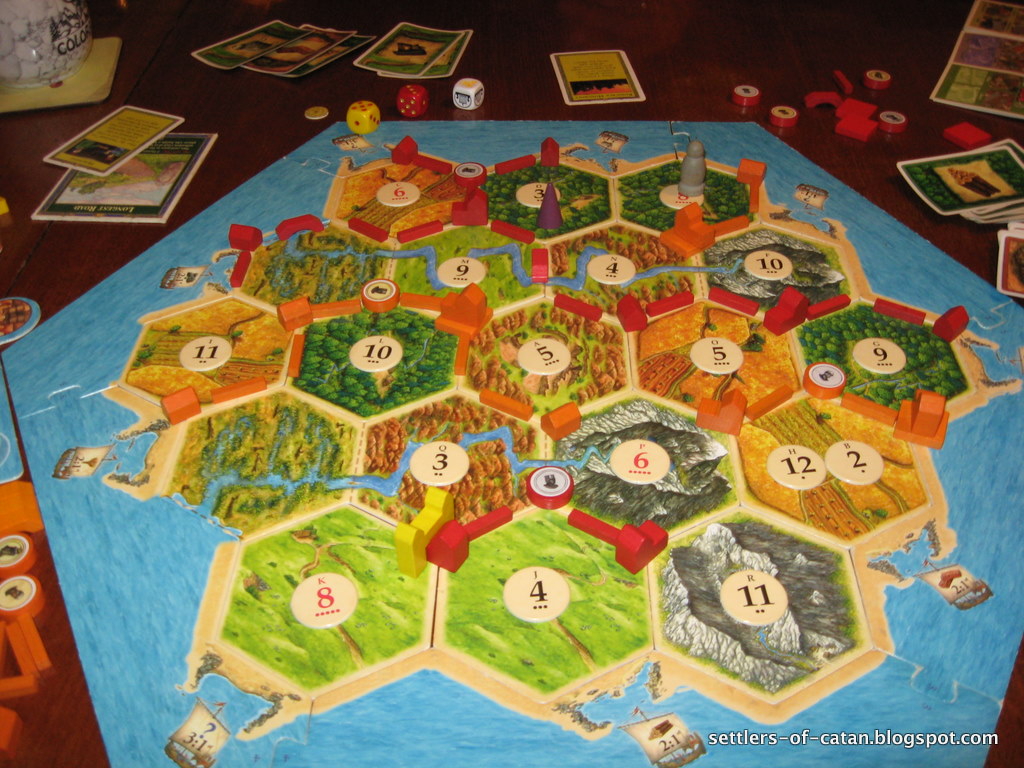
So we got out three boxes, and set up the game, complete with the rivers on the board in place of a few hexes, and the bridges to allow us to cross the rivers (at the cost of two brick one one wood). Oh, and the coins, which can be earned from building next to rivers.  Plus all the Cities and Knights paraphernalia:


I rolled to go first, which I prefer not to do in the two-person game; had I gone second, I would have taken exactly the places Richard (red) took with his two settlements, giving all five resources and six different numbers. As it was, remembering that it was Cities and Knights, and that I always like to collect the 'books' resource, I started on the 8-wood hex, hoping to upgrade to a city as soon as possible. I did also take into account that clay (bricks) looked as if they might be scarce, so was pleased to start on the best clay resource on the board. 

I then placed my city on the next best wood hex, which also gave access to sheep. 


Since we had, inevitably, both built at least some of our starting pieces next to one of the rivers, we both had some coins. We had decided that, with only two of us, we would ignore the 'wealthy' and 'poor settler' cards; this meant that neither of us had any incentive to hang onto coins, so we both used them to buy what we needed (two coins buys one card in the Rivers of Catan scenario) to get our first settlements: 


This meant that the robber and the event die came into play after just two rounds, and the game progressed rapidly. Clay was not in such short supply as we expected, so I fortified my city quickly with two clay cards - that enabled me to have 11 in my hand before the robber would strike, rather than the usual 9 which we allow in the two-person game. 

We both built an extra city fairly quickly, then only just managed to have sufficient knights to defend us when the pirate ship arrived on the shores of Catan for the first time:


Richard had seven points by this stage, and I was lagging behind with five.

We had the same number of knights, so each took a resource card of our choice. We always choose the green 'building' ones if we can, as they tend to be the most useful. Richard's was the 'alchemist' that allowed him to switch two numbers of his choice (excluding 6, 8, 2 or 12). So he exchanged the 5 on wheat (which I had) with the 11 on ore (which he had): 


My green resource card was even more useful - a street-building one, which enabled me to place two streets, something I had been struggling to do.  I had a free city fortification too, so used that, giving me 13 cards allowable before the robber could steal from me. 

A few moves later, since Richard had the resources, and wanted the ore harbour, he built his first bridge: 


That gave him the longest street, but then I managed to build two more streets - an 11 was rolled, giving me plenty of clay - so I took the card from him: 


Then I picked up an alchemist card, meaning I too could switch two numbers. I took the 5 which Richard had placed on ore, and changed it with the 11 on clay, which would theoretically benefit us both:


I say 'theoretically', because as it happened, 11s were rolled rather more often than 5s in this game!

Richard collected the merchant card and using it on wood, of which he had an abundance, right before the pirate struck for the second time:


Although I had the longest street, I only nine points on the board (making 11 in total). Richard had ten on the board, plus the merchant, giving him also 11. So we were neck and neck at this point (not that we actually counted points while playing). 

However, Richard was doing well with the cloth resource cards, and managed to get to metropolis level: 


Little did I know his dastardly plan, which was to build another bridge, and take the longest street card back from me: 


We had both, by this stage, built all four cities.  He also had four settlements on the board, giving him 12 building points, plus two for the metropolis, two for the longest street, and one extra for the merchant. He only needed one more point... and managed it, building his final settlement:

So he was the resounding winner, and I had, simply, 12 points from what I had built. 


I didn't build a single bridge, and neither of us had any victory points at all. 

Thursday, 25 August 2011

Settlers of Catan with very few building spots!

Last night, for the first time in a while, we played a four-person Settlers game with our friends Jörn and Sheila.

After our initial setup, Sheila spotted that the central 11-sheep hex was entirely inaccessible. None of us could remember seeing that kind of scenario before - but with six settlements arranged around the middle 'circle' of hexes, there were no spots at all available to be used on the central one.

I didn't think to take a photograph until we were fairly well into the game, when we realised that that, with only 18 cities or settlements, we had actually run out of building spots entirely:


Sheila, playing brown, had the longest street and so was well in the lead at this stage, with 10 points and five buildings; Richard (red) was second with 6 points; he also had managed five building spots. Jörn (blue) and I (orange) had only managed to grab four building spots each, and were tied in bottom place with five points. While it's possible to win with only four building spots, it's not easy. I prefer at least five. I did wonder whether I could get the 'largest army' but with sheep in fairly poor supply, it was difficult to buy many cards.

Strangely enough, as we upgraded our settlements as far as we could, 11s and 4s were rolled more than would be expected, and at one point I was able to 'monopolise' sheep, gaining 13 of them. With no harbours I had to trade rather heavily, but it did at least enable me to upgrade to another city and buy a further card.

I did get a victory point, and two knights.. but Jörn got in with a third knight first, and the largest army. Richard took the longest street from Sheila - and built sufficient roads that it could not be taken back - and suddenly our scores were more even: at one point we were on 9, 8, 7 and 6 points. Theoretically it could have been anyone's game, except that eventually there was nothing to do other than buy cards.

It was Sheila who won in the end, playing a fourth knight and thus taking the largest army, as well as producing two victory point cards. So she won with 13 points. Richard was second with 10, I had 9 (including my victory point), and Jörn was back to 6.


Tuesday, 25 May 2010

Four person Cities and Knights of Catan

For the first time, the four of us were at home for an evening together. It was four weeks since the last time Richard and I played Cities and Knights, and we realised we had never played it with four people.

Richard (playing red pieces) rolled highest, and placed first. I didn't think his choice - the 3-4-8 intersection near the top of the board - was all that great. Becky (blue) took what I thought was the best choice from the city-improvement perspective: a 5-9-10 intersection on sheep, ore and wood respectively. All she needed to do was to upgrade to a city, and she would then have a good chance of collecting all three Catan commodities.

Daniel (brown) took another great spot from the number perspective, including a 6 on clay, and also a 4 on wheat. I had already spotted that wheat was likely to be in serious shortage in this game. So when it was my turn to place both my settlement and my city, I chose some reasonable numbers that included that 4-wheat, and access to all five resources. I particularly liked the idea that any time an 8 was rolled, I would collect a street.

I then forgot to take a photo until we'd played our first round, and built some streets. Richard had even bought and activated his first knight. I remembered just as Becky was placing the first new settlement of the game:


My initial plan was to head for the useful 9-10-5 intersection with two sheep and an ore. Unfortunately, Daniel had the same idea. And when he realised that I would get there before he could, he built a settlement on the 2-5-9 intersection, which gave him a building spot (albeit not as useful) and effectively blocked me from the one I wanted. But I shrugged, and built another street, thinking I would take the 9-10-11 intersection with sheep, ore and wheat.

Alas for my plans. Richard built in that direction, and built a settlement on the adjacent 3-10-11... so I was stymied again.

So I decided on my next move I would head towards the coast from my city, towards the 3:1 harbour... only to find that Daniel had picked up a street-building progress card, enabling him to stop me in my tracks from that one too. He picked up the longest street at the same time, putting him in the lead with six points already:


Richard had five points, Becky had four, and I was still on my initial three... and beginning to run out of building spots already.

It wasn't long before the barbarians made their first landing to Catan. Between us, we had sufficient activated knights to stop them: two for Richard, two for Becky, and two for me.


So we each picked up a progress card of our choice since nobody was the outright Defender of Catan.

I had at least managed to build one settlement by that stage, on the wheat harbour. Not that I was getting a lot of wheat (indeed, I don't think I used it for trading in the entire game), but it was a building spot.

Since I was having such a hard time building settlements, I concentrated for a while on city improvements, and before too long was able to gain Metropolis level with wood. Rather a lot of 8s had been rolled, and other people seemed happy to trade with me.


And the barbarians attacked again. This time, Richard had the most knight power, so gained an extra victory point as Defender of Catan.


So Richard was in the lead with 9 points. Daniel right behind with 8 (including the longest street) and I had 7, including my metropolis. Becky, who had picked up a victory point progress card, had 6.. and kept just missing the opportunity to build a settlement, despite having plenty of building spots. She simply wasn't getting wheat, nor many sheep (since 5s came up only rarely). She had managed to build her city in the useful spot with three potential commodities, but none of those numbers were rolled all that frequently.

By the next barbarian attack, I had managed to build another settlement and upgrade it to a city. I'd also built more streets - hoping for (and succeeding in) one more building spot on the 2 - and Daniel pointed out that my longest street was now longer than his. So that gave me two more points.

Richard and Daniel shared the most knights at this next attack, so no more victory points were awarded; but they both had another progress card to pick up.


Suddenly I realised that I was in the lead with 12 points. Richard, with his one Defender of Catan victory point, was close behind with 11. Daniel had 8, and Becky was still on 6. The booklet said that we should play to 13 points, so we decided that 15 was a reasonable number to aim for.

The next excitement was that Richard managed metropolis level on the cloth commodity improvements. So he now had 13 points. And Daniel extended his roads, giving him back the longest street card. He had control of the merchant, too, so he had 11 points. I was back to 10, and Becky - who had had a sudden spate of success in building - had 8.


I was expecting the game to go on for a while longer... then Richard built some more streets. Daniel's longest street had eight pieces, and Richard's had 9. So he had two more points, making him the winner with 15. And then he showed that he had the merchant card, so he took that as well, meaning he had in fact won with 16 points.


It was a pretty strong victory, I was second with 10 points, Becky was close behind with 9, and Daniel was just behind again with 8.

As we were talking about the game and starting to clear away, Daniel took the camera. He switched to sepia to take this rather nice picture of Richard:


.. and a black-and-white picture of the robber:


... and this, showing both the merchant (artistically out of focus, close to the camera) and the robber in the distance:

Friday, 19 February 2010

Cities and Knights game for two again

After playing a long five-person Seafarers game last Sunday, and a very enjoyable Settlers game on Tuesday, we decided to have a two-person Cities and Knights game yesterday evening. The board looked very small after playing the two extensions earlier in the week, and it took us a moment to remember the variations necessary for a two-player game!

I placed my first settlement on what looked like a useful intersection with ore, wood and sheep (which give commodity cards when the settlement is upgraded to a city), and two good numbers: 5, 6 and 11. Richard then placed his two settlements so as to get all five resources, and a fair selection of numbers. I then put my second settlement and city using similar strategy, although I was lacking the 8 and the 4. I placed my city on an intersection with two wood and sheep, which would give me the cloth and book commodities, since I like the relevant cards much better than those associated with coins (which come from ore). Richard then placed his city in the place I'd considered... giving him two ore hexes next to his initial city.


So we played for twenty minutes or so, during which time Richard did indeed gain a lot of coin commodity cards, and was able to build city improvements using them right up to metropolis level surprisingly fast. He also gained victory cards for the first two barbarian attacks. I wasn't too happy about that; I'd bought a two-ring knight fairly early in the game and activiated it, and Richard also had an active two-ring knight. We had four cities in all by the first attack, so should have received one card of our choice each. However... one of the 'coin' related cards Richard had collected was the 'deserter' card which enabled him to remove my knight and have a free knight himself of the same status. Thereafter, although I did buy another knight, I was never able to catch him up. However I managed the longest street card, and kept hold of that, which was something.


By the third barbarian attack, we hadn't been counting our cities carefully enough... and the barbarians won! Since Richard had the stronger knight force, I had to give up one of my cities and return it to a settlement.


I did manage to gain the metropolis using the book commodity cards, which gave me an extra two points, and I did have control of the merchant for almost the entire game, which was useful. Particularly when I also picked up the card enabling me to have six free wheat cards (since I had settlements bordering three wheat hexes) and could thus build a settlement using seven wheat (since the merchant was on wheat).

It was quite close near the end. I had worked out that Richard had 17 points: 12 in buildings, 2 for his metropolis, and three 'defender of Catan' cards. I had 16: 10 in buildings, 2 for my metropolis, 2 for the longest street, one for the merchant, and one for a victory point progress card which I had picked up. I had also worked out that, by careful trading, I could manage the commodity cards necessary to take the final metropolis - so long as Richard didn't - and win by a breadth.

He was also working out whether he could take that metropolis, but realised that he couldn't. However, when I pointed out that he only needed one more point to win, he built his final settlement, taking him to 18 points.

Monday, 8 February 2010

Cities and Knights game for two

It was only 8pm, so we decided to play another round of Cities and Knights. I still find it a lot more mentally tiring than other variations of Settlers of Catan, but Richard likes it best and it's certainly an interesting game.

Initial set-up strategy is a little different from the other games. Wheat is vital, so as to enable knights to be active - I did remember that much. But it's also important to ensure that cities can be built (and preferably the one initial city) on intersections with wood, sheep and ore hexes, so as to gain the commodity cards that enable city improvements. Richard usually does better than me with that - and since he got to start, he was able to take what was clearly the best place from that point of view. I concentrated primarily on wheat.


After the first three rounds, we started rolling the event die as well as the two number dice, and the barbarians advanced rapidly. Indeed, there were so many barbarian faces rolled that they got to Catan before we had anything like enough active knights.


So nobody gained a victory point as 'defender of Catan', and I lost one of my cities: demoted to a settlement. Ah well.

Play proceeded fairly rapidly, with not much building being done. I was pleased to pick up the merchant card, and placed it on a sheep hex since I had a lot of sheep and the two-to-one trading was useful in buying another settlement.

I did also manage to buy another knight, and had high hopes of being defender of Catan... but alas, Richard picked up one of those most unpleasant 'deserter' cards, meaning that he got to place a knight at no cost, in place of one of mine. From that point onwards, he had continually more knights in the game than I did, although I never again lost a city.

The second time the barbarians attacked, Richard gained a victory point as 'defender of Catan'.


Tessie, who's determined that Richard is her current person, insisted on sitting on him while we played. That was fine at the beginning, when she was asleep, but she suddenly decided that dice would make rather interesting toys:


I think the barbarians must have been a little scared of Tessie, as are most of the neighbourhood cats, since the next few rounds gave us fewer of the barbarian rolls, and more of the coloured faces, enabling us to pick up more progress cards and also to expand our buildings. I realised I was only likely to gain one metropolis, so I went all out for that, and also took the longest street card. Richard managed a metropolis too, shortly afterwards. He also got control of the merchant, which deducted a victory point from me and gave an extra one to him.

I forgot to take a photo of the next barbarian attack - but once again Richard gained a victory point. Earlier in the game I had been ahead on points, but now he had clearly taken the lead.

Before long the final barbarian attack took place:


I had 13 points on the board (including my metropolis) and the longest street card, giving me 15. Richard had 12 points in buildings, including his metropolis, one point for the merchant, three 'defender of Catan' cards, and one victory point card which he'd picked up as a progress card. 17 in all, and we play to 18.

I don't think he'd realised how close he was, however; so after we'd dealt with the barbarian attack and de-activated the knights, he built two streets (with one of the useful street-building cards) and a settlement. So he had 18 points, and was the winner:


It seemed very abrupt; if I hadn't counted up we wouldn't have realised. It was tempting, for a moment, to continue... but we remembered that this game tends to get tedious after 18 points, and that it's definitely the time to stop.

So Richard was clearly the winner this time.

Friday, 22 January 2010

Cities and Knights for two players

We were ready to play a game by about 7.45pm last night, so plenty of time for a round of Cities and Knights.

I started, and chose what looked like a good spot for my first settlement, on the clay-ore-wheat intersection, giving me 8, 4 and 10 as my numbers. It looked as if wheat and clay would be the most difficult resources to get hold of, so I thought I'd make sure of some - unless the dice behaved very erratically - and also some good ore.

Richard then played his two settlements roughly where I expected him to, the first one on an intersection that would make a nice upgrade to a city (since city improvement commodities come with sheep, ore and wood), and the other in the place where I'd have liked my second settlement, with the other resources and some more useful numbers.

With no useful way to access the 6-clay hex, I placed my second settlement on one that bordered two clay tiles - 9 and 10 - and a sheep, and my city then went on a border with two sheep and a wood; more numbers, and immediate access to some commodities. Richard was slightly surprised I hadn't taken the other intersection with all three potential commodities available - however I was put off by the 2 on ore. So he took that one for his city.

I forgot to take a photo until we'd played a round of the game and had both built an extra street, so here's what it looked like at that point:


The game moved fairly swiftly. I expanded fairly easily, building settlements and cities, but didn't gain commodity cards as quickly as Richard did. He reached metropolis level on coins surprisingly early in the game. I did manage to buy knights, and activate them; so the first two times the barbarians attacked, I won another victory point as 'defender of Catan'.

He continued being able to improve his cities. He picked up four instances of the 'merchant' card, enabling him to trade 2:1 on different resources, as appropriate (and an extra point for that). And he managed to achieve two more metropolises. Since I was still at the third level for most of the city improvements, and thought there was little chance of overtaking Richard, I did deliberately build my roads so as to take the longest street card, albeit with only six.

For some reason, we decided to count up our points when I'd built my last settlement. I had 13 points on the board, 2 for the street and 2 extra defender points. 17 in all.

Richard had only three cities and three settlements... 9 points, plus three metropolises giving him an extra 6. He controlled the merchant - throughout the game - and also picked up a victory point progress card. 17 in all. We were playing to 18 points, so whoever gained one more point would be the winner...


My only hope was picking up a victory point, or possibly being Defender of Catan again. All Richard needed to do was to join his two sections of roads, to take the card from me. Which is precisely what he did:


So he won the game with 19 points, to my 15.

Except that we decided we'd just play a few more rounds until the barbarians attacked again....

But by that stage, I'd managed to build yet more roads, and had taken the longest street card once more.


What's more, although it can't really be made out with the smaller size of photos I've uploaded, we had exactly the same number of knights. We each had one 'mighty' knight and one 'strong' knight on the board. Meaning that neither of us gained a victory point; instead we both picked up a progress card. So we were back at 17 points each.

Which meant that we had to play another few rounds until the barbarians attacked once more....

So Richard built more roads, to take the longest street card back. And I built my last few, and took it again...


... and since I'd now built everything I could, I concentrated instead on commodities. I was lucky, and was able to build one to the fifth level, meaning I took one of Richard's metropolises.


So I had 19 points, and he had 16 points (since had had by that stage built another settlement) - so our positions were reversed. But the barbarians hadn't yet attacked for the last time, so we kept playing...

He built his last city. He built more streets to take the card back from me. Now he had 19 points, and I had 17.


He collected sufficient commodity cards to upgrade his city improvements to the last levels, meaning that his two remaining metropolises were secure. And he built his last two settlements. He also managed to have more knights than I did, giving him one final victory point when the barbarians attacked for the last time:


So he won resoundingly, with 22 points (13 for regular buildings, 4 metropolis points, 2 for the street card, 1 victory point, 1 defender point, 1 merchant point). I was still on 17. The last few rounds were actually a bit dull; by that stage I had nothing left to buy other than knights. I continued improving my cities so I'd be able to pick up more progress cards, but most of those weren't a lot of use either. The only ones that would have helped me are victory point cards, and I didn't get any of those.

Once again, we made a decision - as we had before! - that we would stop when one player reaches 18 points. It does feel as if the game should continue when that happens... but if we keep playing, it gets rather tedious. 18 is a good number for two-player Cities and Knights.

Tuesday, 12 January 2010

Two-player Cities and Knights

We played our first ever game of Cities and Knights a couple of weeks ago, when Tim - with the aid of the rules - taught us the basics. The following day, we played a shorter Cities and Knights game, just so as to consolidate it in our minds.

But that's a fortnight ago. Since then we'd rather put off the idea of playing it again in evenings, since it's so much more complicated than either the basic Settlers of Catan or Seafarers. However, we were worried that we might forget altogether... so last night, feeling a little more wide awake than usual, we set out a Cities and Knights game, deciding to play with our basic two-player Settlers house rules. I had the rule booklet open next to me, and referred to it frequently.

As we took the pieces from the box, our memories were slightly refreshed. Knights - white for non-active, yellow for active - are the little round pieces. City fortifications are the square blocks. The barbarian is in a black ship, and sails on a little track towards Catan. When he attacks - after the third die has shown black sufficient times - there must be at least as many active knight forces as cities.

Then there are the little booklets that replace the building cards, and allow us to improve our cities to gain additional benefits. And the little yellow things, only partly showing on the photo, are the metropolis pieces... but they don't come into the game until later on, so we didn't really think about them. A mistake, as it turned out...


In our usual two-player game of either Settlers or Seafarers, we start with three settlements rather than two. In the regular Cities and Knights game, players start with one settlement and one city. So we decided we would begin with two settlements, and then a city. That seemed to work well. However, both of us had forgotten that the balance of resources is rather different in Cities and Knights. Both sheep and wheat become more important: a knight requires a sheep and an ore resource to be bought, and then a wheat to activate. Every time the barbarian ship attacks, or the knight kicks the robber out of the way, he becomes deactivated and another wheat must be paid to feed him, to make him active again.

I forgot to take a photo immediately after our initial placement, then remembered after a couple of rounds, by which time I'd managed to buy a knight (playing orange, as usual), but nothing much else had happened. As can be seen from this photo, Richard had considerably better access to wheat than I had. More by luck than judgement... had I remembered how vital it as as a resource, I would definitely have chosen my initial settlements differently.


The dice, for once, decided - so to speak - to play ball, and follow expected statistics. A huge number of 8s and 6s were rolled in this game, and an even greater number of 7s. We decided fairly quickly that whereas in our usual two-player games, the robber is controlled by whoever has fewer victory points (when a 7 is rolled), this time we would play as in the normal game, with the robber controlled by whoever rolled the 7. It made life a bit easier. However, rather than taking a random resource from the bank, we decided it would be more interesting to take from the bank whatever resource matched the new landing place of the robber. We may well adopt that into our regular house rules for two-player games.

Although our placement of initial cities was somewhat random, we did both happen to put them on places where there were the commodity cards - ore, sheep and wood - meaning that instead of two resource cards, we received one resource and one matching commodity card. Commodity cards are needed to build the improvements to cities... and it's only after building city improvements that one has a chance to pick up the progress cards which replace Catan development cards.

Richard was lucky enough to pick up a 'merchant' card fairly early in the game, which enabled him to trade 2:1 with a resource of his choice for as long as he held it. He put it on wheat, which he was receiving - if I can exaggerate slightly - by the bushelful. Player-to-player trading would have been quite nice in this game since I was so very short of wheat, but I did eventually manage to extend towards the 8-wheat hex, and build first a settlement, then a city there, which helped my wheat production significantly.


We couldn't quite decide how many points to play to. The booklet says 13, and we usually go at least 2 points ahead of that with a regular game, and maybe two or three more for two players. Richard suggested 23... we thought perhaps 17 or 18 would work. While there aren't Victory Point development cards, there are extra points given for whoever has the stronger knight force after every successful defeat of barbarians. I had a couple of those early in the game, and Richard had one later on.

So we reached the stage where we both all my cities and settlements built. We still hadn't decided how many points to play to, so thought we'd simply continue until 10pm and then count up. I had the longest street card at one point, but Richard took it after a few rounds, and I realised I couldn't take it back. That meant he had 16 points, and I had 15. The barbarians attacked again, and Richard had the strongest knight force once more, so it took him to 17 points. Not that we were really counting.

Ten o'clock came, and we finished the round. I looked in the rule book and discovered that whoever controls the merchant gets an extra victory point for that. So Richard actually had 18, and a resounding win.


It wasn't until we'd started putting the pieces away, and realised we hadn't used any of the metrolopolis blocks. I had vaguely thought they were used when one had finished improving the city - ie the fifth level in the flip chart. I was wrong: when we checked, we discovered that they should have been used after the fourth level. Richard had reached the third level in all three of his kinds of city, but I had reached the fourth level in two of them. I should thus have built two metropolises (or is it metropoloi?) which would have given me an extra two victory points each. So, had I only known it, I really had not 15 but 19 to Richard's 18.

Still, something similar happened the other way around when we played 'the lost tribe' (Seafarers) - I was declared the winner, only to realise that Richard should have won a few rounds previously. Perhaps when we get more used to these games we'll think to count points more carefully, and be a little more competitive, but at present we just enjoy the process of playing.

Catan: Explorers and Pirates (first game, scenario 1)

Our usual default Catan game is Cities and Knights. It was quite a steep learning curve before we could relax into it, but now we can chat ...