Showing posts with label Settlers: won by Richard. Show all posts

Thursday, 22 December 2011

A most efficient layout on a six-person Catan game

A few weeks ago, we were playing a six-person Settlers of Catan game, with our usual friends and one friend's parents. A six-player game can, of course, lead to rather an over-crowded board, but as we progressed through the game, it seemed that nobody had run out of building spots early on.

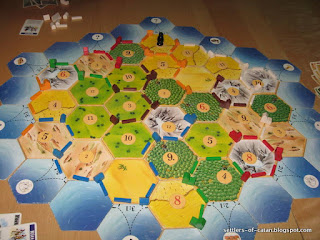
It wasn't until about half-way through that I suddenly realised what a remarkably efficient layout we had managed to produce:


Quite by accident, none of our settlements was directly opposite another on any hex. So, theoretically, we had the maximum possible number of building spots. Blue, green and orange had all run out of new spots by this stage, but each had managed six. Red had six already, and one more. And there were four remaining spots which could be accessed by either white or brown.

As it happened, the game did not continue for many more rounds after that. Here's the final board:


I think it was Richard (red) who won, with the largest army (or perhaps two victory points) as well as ten points on the board.

Wednesday, 29 September 2010

Settlers of Catan for two of us

Monday evening, and nothing planned... so out came the Catan box for another two-player game. Orange pieces for me, red for Richard, as usual. It would be very confusing if we ever decided to change colours!

Richard rolled the higher number, so - according to our two-player Settlers house rules - he would place his first settlement, then I would place two (taking resources cards for one of them) then he would place two more (taking resource cards for both) and I would then place my final one, taking resource cards for that too. We allow nine in a hand before the robber can attack, and two or three robber-free rounds at the beginning anyway.

Richard said that he was going to use 'my' strategy of starting on the best hex for whichever resource was likely to be scarcest. As it happened, there weren't any obviously lacking resources on this board, but I thought clay and wood would be the most problematical. So I expected Richard to start on either the 4-clay or the 9-wood; most likely, I thought, the useful 5-9-10 combination with sheep, wood and clay respectively.

However, to my surprise, he didn't take either of my chosen spots - instead he opted for the 3-4-8 with wood (on three only) and two ore. That meant that I could place my first two settlements on the two spots I had marked out as the best ones, which gave me five good numbers and access to all five resources.

Richard then took the 5-9-10 with two wheat and wood, and - after some consideration - the 3-4-8 with two clay and a sheep. He liked that spot, which was undoubtedly the best remaining one for clay, but didn't like the fact that it had exactly the same number combination as his first settlement.

As I looked for a spot to place my final settlement, my main aim was access to an 8, since I already had 4, 5, 6, 9 and 10. Since I like having good ore access, I opted for the 8-10-desert hex with ore on 8 and wood on 10. The wood harbour looked rather attractive and convenient too.


Clay and wood were not lacking in the early stages of the game, so we placed streets, and Richard bought a few development cards too. 9s were not rolled, which was a bit annoying since it meant that I could not build a settlement, having no wheat - and nor could I buy any cards. I had to trade four ore, at one point, for one wheat in order to take the sheep harbour, and then trade heavily again for my second settlement.

Then suddenly we rolled three nines in a row, and, with plentiful ore, I was able to build my first city.

However, I had made a strategic error in not securing a spot on the wood harbour; I placed my first two streets next to the other two I had started with, leaving the way open for Richard, who was collecting a lot of wood and clay, to race past me for the wood harbour:


I was ahead at this point in the game (six points, while Richard had four) but he had already played a knight, and had two or three other hidden development cards. As with the last game we played, we decided that the robber would be controlled by whoever rolled a seven (rather than whoever was behind in points) and also that the robber would always steal from the bank - rather than the other player - a resource matching whatever hex he was placed on.

I really wanted a spot on that 5-wheat hex, since wheat was my weak point in this game. Richard had in fact placed his initial settlements as if he were using the 'ore-wheat' strategy, and was beginning, as a result, to get ahead. So I played him at his game, storing up clay and wood until I could push past him to the 2-5 wheat spot on the coast. In doing so, I took the longest street card... for about twenty seconds. Richard then built more streets and took it from me, for the rest of the game.


So I still had six points, while he now had nine. He had also played two knights, so was likely to achieve the 'largest army' too.

And, indeed, that's what happened. We both continued building on just about every turn - in fact Richard reached 16 points before either of us had realised it, and so won the game with 17 points, including both the largest army and the longest street:


I did have one victory point, so I lost with 11 rather than just the ten points I had on the board.

Thursday, 12 August 2010

Three-person Settlers of Catan with Sheila

Shortly before we finished our three-person Settlers game with Tim, our friend Sheila arrived. It was only just nine o'clock when we had finished it, so we decided we'd play a game with her - Tim wanted to do something else at that stage.

Sheila (with brown pieces) rolled to go first. She likes to use the wood-clay strategy, so she opted for the 3-8-10 intersection with sheep, clay and wood. I was second, again. It didn't look as if any of the resources would be in particularly short supply in this game, so I took the other obviously good place: 5-9-10 on ore, wood, and wheat.

It wasn't such a nice board as in the previous game; I don't know what I'd have done in Richard's shoes. He did manage to get access to all five resources with reasonable numbers, although he wasn't too happy at having two 6s and no 8. I needed clay and sheep, and in the basic Catan game will always sacrifice sheep (so to speak!) when there is a necessary choice. So I built on the coastal 4-8 with wheat and clay as my second choice.

Sheila then had a difficult decision. Ore is crucial, and there was nowhere to build on one of the good ore hexes. So after some pondering, she took the 5-10 coastal intersection with ore and wood. She wasn't too happy about having only four numbers, and no wheat; but the only real alternative was the 4-6-11 on three wheat, which would have left her lacking ore.


There was plenty of clay and wood in this game, so we all managed to build the streets we needed early on without much difficulty. I decided to aim for the 8-sheep hex, taking the ore harbour along the way (not that it was particularly useful to me). Richard aimed for the same 8-sheep hex, gaining access to the 4-sheep hex at the same time. He also built an early city, and then headed out to a 3:1 harbour.

He said later on that he decided to try and get access to all the possible numbers if he could. Even by this stage of the game, fairly early, he had managed to get 3, 4, 5, 6, 8, 9 and 10, and was clearly heading for a 10 and 11.


We thought that Richard was just in the lead at this stage, with five points, then we realised he had the longest street. So in fact he had seven. I had four, and Sheila still had two.

I'm not quite sure how it happened, but there seemed to be no stopping Richard in this game. I suppose it was due to his having so many numbers available - all he lacked was a 2. That meant that he picked up a lot of resources; when he was worried about getting too many, he bought a development card, but he frequently found himself able to build too. His longest street got longer, and he took the wheat harbour. All I managed was one upgrade to a city and one more street in that time, while Sheila had very bad luck with the roll of the dice, and didn't manage any building at all.


So Richard was zooming ahead. He had ten points, including the longest street. I had five points, Sheila had two.

The end was not far away. Richard had already played two knights, so when his next turn came around he played the third. That gave him the largest army, and two more points, which made him the runaway winner:


The whole game had only lasted about 45 minutes.

Monday, 9 August 2010

Settlers of Catan in the evening

The same group that met for a Catan game last Thursday evening gathered once more. This time, John and Sarah played separately but Richard and Tim formed a team. They play very differently from each other, so it was interesting to know how they would work together.

They rolled to go first. Playing Richard's usual red pieces, they had some discussion about starting but opted for the good numbers of 5, 8 and 9 on sheep, ore and clay respectively.

Sheila was second, with her usual brown pieces. She opted for the other obvious place: 4-6-9 on ore, wood and clay. That would probably have been my starting spot of choice, had I played first. The numbers were not quite so good as Tim and Richard's choice, but wood is generally more useful than sheep. Then again.. it didn't look as if there would be a lot of sheep in the game, if numbers were rolled as expected.

I was third. With the two prime locations taken, I decided to opt for numbers rather than three resources. So, playing orange as usual, I took the 5-8-9 on two wheat and wood. Of course I had a faint hope that I might be able to access the wheat harbour.. but it seemed pretty unlikely that it would still be available.

As it happened, it wasn't until John (playing white) got to place his settlements that the rather nice 4-6-10 (two ore and wood) intersection was taken. He went for numbers rather than resources, it seemed, since he started without either sheep or wheat.

Jörn (blue) and Sarah (green) played in between John and me; both of them were able to access all five resources, at least in theory, with their placements, and also had a reasonable selection of numbers. So by the time I got to place again, there wasn't much available. I decided that it was most important to have ore, and I really wanted a 6 if possible. So I opted for the coastal 6-4 spot, which gave me yet more wheat in addition to a useful ore place. Possibly I should have placed my street heading inland since I had little hope of getting to the wood harbour before Sarah did, but I knew I had plenty of space for expansion in the wheat section near my first settlement.


By the end, Tim and Richard probably had the best selection of numbers, although I was quite pleased with mine too. They were lacking wheat; I was lacking both sheep and clay.

With plentiful ore and wheat, I managed to build my first two cities fairly easily. Sarah took the wood harbour, so I knew I would have to do any expansion via my other settlement. Clay was somewhat at a premium, but others wanted wheat so I was able to trade, and built a couple of settlements around the 8-wheat hex. John expanded towards the wheat section too, since that was a resource he lacked; in doing so, he was the first to take the longest street card.

I was actually in the lead at this point in the game, with six points. This seemed rather surprising, since the lack of clay was holding me back. I had considered expanding out towards the 5-clay hex, but only ever managed one set of street resources at a time. If I had built one, or even two streets, I could pretty much guarantee that Jörn would have then built one of his to block me.


Sarah, who also had good access to ore and wheat, had also built two cities and had five points. John also had five, with the longest street card, as did Tim and Richard. Jörn and Sheila each had four. It was still very even.

I continued being lucky with rolls and trading, and was able to expand further inland to take a double-wood slot next to the desert. Although, unfortunately, I then kept forgetting to take the relevant wood resources when a 6 was rolled! I was handed the longest street card, which put me more firmly in the lead with eleven points. All I needed was one more city, and I would have won... although I'm pretty sure I did not realise this at the time!


Tim and Richard had built all their cities by this stage - despite still lacking wheat - and had nine points. Sheila had seven, and everyone else had six.

My hope of victory diminished when Jörn joined up his sections of street, and thus took the longest street card with nobody able to take it from him.

Finally I had the resources for three streets in my hand, so I built out towards the 5-clay hex. Not that clay was going to do me much good at this stage - but it was another building spot. Sheila had taken the ore-wheat one which I'd hoped to take near my main expansions so this was my last possible place to build.

So, once again, it could almost have been anybody's game. Tim and Richard were now in the lead with ten points, but Jörn and I were both right behind with nine points each. Sarah and Sheila each had eight, and John had seven. John still had three possible building spots; I had one, Richard and Tim shared one possibility with John; I had the one on the clay which I technically shared with Jörn, but he needed to build some cities first, and I almost had the cards in my hand for that settlement...

Then it was Richard and Tim's turn. I picked up wood, which was the last resource I needed to built my settlement on their building phase.

Except that there wasn't one. They played a third knight card, thus taking the largest army, and another two points.

Once again, Tim had won. That's three wins in the three games we have played since he arrived here last Thursday. According to my statistics on the side of this blog, he's now won 10 out of the 20 games which he's played with us since I started recording them at the end of last year.


Still, nobody was completely trounced. Jörn had ten points, Sarah had eight, and the rest of us each had nine.

Sunday, 25 July 2010

Five-person Settlers of Catan

After an enjoyable meal with our friends, the children went to bed and the rest of us started another game of Settlers.

John rolled to go first. He was playing with the white pieces, and with the entire board to choose from, opted for a coastal spot. It was certainly the best place for wood and clay (10 and 8 respectively) and gave him the ore harbour too... but not a spot I would even have considered when playing first, particularly since there weren't any particularly nice places nearby to aim for.

Richard (red) was second, and chose the exact spot I would have liked. Ore was evidently going to be in somewhat short supply in this game, so clearly the 6-ore hex was worth grabbing. He took it, along with a useful 5 on wood, and 10 on wheat.

I was third, with my usual orange pieces. So I took the other spot that had three resources and good numbers - actually slightly better numbers than Richard's, statistically speaking (5-8-9) but with sheep rather than the more useful ore. Sheila said she would have taken the one next to it (with the 4 on clay rather than the 9 on sheep) - but I no longer worry about having both clay and wood at the start of the game, and 9 is a slightly more useful number than 4, in general.

Sheila (brown) was fourth; since there were no places left with three good numbers and three different resources, she opted for the 5-6-9 intersection with two wood and a sheep. That's what I'd have taken in her position. Jörn (blue) played last; with the advantage of being able to place both settlements at the same time, he opted for two reasonable spots, giving him access to all five resources, and five useful numbers (3, 6, 8, 9 and 10) as well as a 12 on clay.

On the way back around the table, we all attempted to get hold of the numbers and/or resources we were lacking. I could not get hold of both ore and clay; so although I did consider the 3-6 coastal hex with two ore, it was quite a crowded place already, and I prefer room to manoevre without too many people trying to get the same spots. So I shrugged mentally, and chose three other reasonable numbers, giving me clay on 5, and two more sheep hexes. I realised that there was no way I could get to a sheep harbour, and in retrospect I think the place with two ore would have been more useful - but I didn't go for it.


The most surprising second placement was John's, who built simply on the 6-ore hex by the sea. He didn't even take the 3-6 intersection which I had considered. He said his strategy was to take harbours (and, indeed, the spot he chose was right on the wood harbour) but it gave him only three numbers in all, and not a whole lot of scope for expansion into other useful numbers.

So we started the game, and unsurprisingly I collected quite a few sheep. 3s were rolled a few times, giving access to ore, so I was able to trade for it and buy one or two cards. Mostly I concentrated on expanding to start new settlements, and succeeded in getting a spot on ore, albeit with an 11. Richard had hoped for the nearby spot with a 10 on wheat - actually I'd quite have liked that one too, but thought it better to secure the one I could easily take rather than push further away and risk losing the spot altogether.

Richard and Jörn each managed a city reasonably early in the game, John started building roads in order to get to some useful building spots, and Sheila fairly quickly achieved the longest street:


That put her in the lead with six points, but Jörn was close behind with five; Richard had four; John and I each had three. With five players on the larger size Catan board, there's usually a fair amount of room so we weren't really fighting over building spots too much.

Having said that, Richard - who didn't find the intersection with a 12 and two desert hexes too appealing - did make an attempt to build right across the board to grab a place where I actually built, on the 4-11-8 intersection with two clay and wheat. However, in doing so, he gained - by quite a margin - the longest street card:


Although he couldn't extend it any further, the only person who could possibly challenge him was John - and he still had quite a way to go. So Richard now had nine points, including three cities and the longest street. He could still upgrade to another city, he still had the unattractive potential building spot by two desert hexes, and he had played two knight cards... meaning that he would most likely also take the largest army. Richard was in a strong position.

Jörn, meanwhile, had seven points, Sheila had six, I had five, and John had four.

In the next round, I finally succeeded in getting my first city. Sheila played a wood monopoly, which gained her quite a few cards and enabled her to use her useful wood harbour; she was then able to build another settlement, and a city. Jörn and John each managed another settlement too.

But Richard was unbeatable. On his turn, he built another settlement, played a third knight (thus gaining the largest army) and also displayed a hidden victory point card. He was the clear winner, with thirteen points in all.


Sheila did say afterwards that she debated playing a third knight card before Richard did, thus prolonging the game a little - but could not resist playing the monopoly on wood instead, since there was rather a lot of wood to be gained from it. I suspect Richard would have won sooner or later, anyway.

Tuesday, 18 May 2010

Another six-person Settlers of Catan

After our enjoyable foray into Catan on Thursday, our friends invited us to dinner and another game on Saturday. Most of the children went to bed, but Helen was still up, so while the others were setting up I explained a few more of the complexities of Catan to her:


Then we placed our initial settlements. Jörn (blue) was first, and chose a very nice spot with good access to both wood and clay. Richard (red) took another similar location. I (orange) then decided to go for the best numbers I could find amongst the remaining intersections, despite knowing that ore was likely to be a fairly scarce resource. I was pleased to be able to take a 10-ore slot on the second placement, though Daniel (green) had taken the best spot as far as ore was concerned.


Play was fairly slow at first, with Richard and I being the first two to build settlements although Jörn did well with streets, and headed out towards a useful clay spot:


It wasn't long before cities started appearing. 11s were rolled a little more than would be expected, statistically speaking, which helped. By this point in the game, Becky (white) had 6 points including two cities, and was in the lead again. Daniel and Richard each had 4 points; the rest of us were on 3:


It seemed that Becky was on a roll. She soon increased her points to 7 with a third city, while all the rest of us had 4:


Of course, this meant that the robber was placed on Becky at every opportunity. And Jörn, who had such good access to wood and clay, continued to build roads and soon took the longest street card:


Daniel pointed out to Becky that she could join her sections of streets, which would ensure that I didn't gain the card (and she might)... so with several suitable cards in her hand, she built a few more streets. While Jörn had the longest street card, they were in the joint lead with 7 points each; Daniel still had 4 and the rest of us each had 5.


It wasn't long before Becky joined her two street sections, took the card, and was well in the lead again with 9 points. She only had one building spot left, but there wasn't much competition for it. The rest of us, other than Daniel, now had 6 points; Daniel still had 4.


Poor Daniel was thwarted at every point. First Becky had taken one of his building spots; now I hoarded cards until I could build three more streets, then built out to block another one for him. I didn't feel too bad about it, since he'd stopped me from taking the longest street by suggesting that Becky do so!


The board was beginning to fill up. Becky played her final settlement, giving her 10 points. However Sheila had also been building, and was close behind with 9. Richard had 7, although he had bought quite a few development cards at the start of the game, and had played a couple of knights so was evidently aiming for the largest army. Jörn and I each had 6 points, Daniel had 5.


Jörn made an attempt at taking the longest street card from Becky, but she was able to keep it since she had no wastage. She built her last city, so there was nothing for her to do other than buy cards and hope for a victory point - which several of us were doing by this stage in the game. Sheila now had 10 points, as did Richard (including the largest army). Jörn had managed to build some more settlements - not on very useful places, but they still gave him points. So he had 9 by this stage. I had 7, Daniel had 5.


To our surprise, we ran out of development cards. None of us could remember that having happened before. It meant that there was no chance for some of us to win. Richard had planned to buy two more cards on his turn, with some trading... however, he then realised that in fact he could build a final city, so that he was the winner with 12 points.


Several of us did have one victory point card, including Sheila - so she and Becky were in joint second place with 11 points each.

Thursday, 13 May 2010

Settlers of Catan for six of us

Daniel and Becky are now staying for a while; last night our friend Joan and her daughter Emily came over for a meal, and naturally we got out the Catan board afterwards, so we could introduce Em to the game.

Setup was fairly slow, as we explained strategies and rules. Richard (red) was first to place, and took the most obviously good spot including wood and clay. I was second; I did consider the intersection with three wheat hexes, near the wheat harbour, but decided to be boring and went for another place with three reasonable numbers and three resources, again including wood and clay. More importantly it had a 4-ore hex, and I thought ore might well be in short supply. Becky (white) was next - and decided she would go for the wheat harbour. But instead of the intersection with all three wheat hexes, she went for the spot on the harbour itself, concerned that someone else might have blocked her.

Daniel (brown) went next, and took yet another naturally good spot with wood, clay and sheep on useful numbers. Then we advised Emily (green) to take a similar one, although by that stage there weren't such good numbers. Joan (blue) was last; she's played a few times before but we still discussed the options with her. She decided to have access to both an 8 and a 6, although it meant not having any wood to begin with. Then we all placed our second settlements, opting as far as possible for a range of numbers and resources. Nobody obviously had the best position.


Daniel, like Richard, likes to build structures out of his pieces at the start of the game...


So we got started. 9s and 4s were rolled reasonably often, as were 6s (of which I had none) but not, alas, 8s. So after a few rounds all I'd managed to build was a street. Richard had managed two settlements in that time, one of which blocked the spot where Becky was going to go. It seemed a bit early in the game to be fighting over building spaces, but it was a good one from the number point of view. Poor Becky wasn't happy though, particularly as Daniel had already blocked another spot she'd hoped to take.


Richard stayed in the lead- by one point - until Daniel took the longest street card. So now Daniel had six points, and Richard had five. I had managed to build two settlements, eventually, so was third with four points. Joan and Emily each had three, and poor Becky, thwarted at every turn, was still on two.


Since we were playing - supposedly - a friendly game, teaching it to Emily, we continued talking about strategies and possible moves. Richard described the possible ways he could extend his roads in order to take the card from Daniel, but realised that he would no longer be able to join up his two segments. He would like to have placed two extra roads to block Daniel, but hadn't had the resources. Indeed, resources in general seemed difficult to find. 7s were rolled quite often, and a fair number of knights were played, which at least recycled the resources a little.

Daniel was then very magnanimous, and pointed out to Richard that while he couldn't join his two sections of street, he could theoretically build out to Daniel's long street, and place a settlement of his own in order to divide the street into two.

So that's exactly what Richard did:


... which meant that Richard now had the longest street. And eight points. Daniel, Joan and I all had four points, Emily had three, Becky had two. So Richard was way ahead, and was naturally the most targetted with the robber.

I wasn't doing well at all, but eventually I did manage my first city. Becky managed her first extra settlement, too. I thought Richard would race ahead to win before I'd done much more, since he seemed to be building regularly; then in a surprise move Joan built some more streets, after inland building spots, and we realised that her street was longer than Richard's:


So he had seven points, and Joan was second with six. In fact we all secretly knew she really had seven too (though we'd agreed to forget it...) since she'd bought a development card earlier in the game, and asked Richard if she needed to keep it to the end... and he had said that yes, she did. I had five, as did Emily, who had played three knights by this stage and taken the largest army card. Daniel was no longer doing very well at all and had four points, Becky still had only three.

Not much happened in the next round, except that Becky, Emily and I each managed to build another settlement.. and Richard built two more cities. So now he was right ahead again with nine points on the board:


Richard had planned to extend his streets until thwarted by Joan, who made hers still longer. But with a few lucky rolls of the dice he was able to build another two settlements (when we pointed out that yes, he did have another building spot...) - and then produced a victory point card, giving him 12 points.


So once again Richard creamed everyone else. Joan was second with 8 points, Emily and I had 6, Becky and Daniel 5.

Monday, 10 May 2010

Settlers of Catan for five

Our friends were over; some of their children decided to watch a movie, but Jacob said he would rather play Settlers with the adults. We all like the five-player version of the 5-6 player game, since it uses a larger board but there's usually plenty of room for expansion.

Jacob (green) placed first, on a useful 8-9-10 intersection. Jörn (blue) was second, and took an equally useful - at least in theory - 5-6-9 spot. Both had access to ore - something I always like to ensure myself - and were spots I might have chosen had I played first or second.

Richard (red) was third, and took a 6-9-10 spot; good for numbers, but no ore. I was fourth (orange). Since all the obviously good spots with three difference resources and three good numbers had gone, I decided I might as well adopt what's known as the ore-wheat strategy, since the best intersection,number-wise, had two ore and a wheat. I didn't have much hope of the ore harbour, but noted that the wheat harbour was conveniently close. I also noted that, of all resources, wheat was likely to be in shortest supply in the game, so having an 8-wheat hex should be useful.

Sheila (brown) played last, and managed to select a couple of spots which gave her five different numbers and potential access to all five resources. I realised I could not get all I needed, so - as I so often do - decided to sacrifice sheep (so to speak) and went for a clay-clay-wood intersection on 5-8-11.


So the game started, with reasonable progress for us all. Streets were reasonably easy to come by, and since 9s and 10s were rolled with surprising frequency, I was able to build cities rather rapidly. Since ore was an abundant resource in this game, Richard and Jörn also built cities pretty quickly. And Jacob gained the longest street card.


We were fairly even at that point. I was just in the lead with 8 points, Sheila had 7, Jörn and Jacob both 6, and Richard had 5 (one settlement slightly off the photo).

Gradually Sheila took the lead. She was also building up her roads, in the hope of gaining the longest street card. Within a few more rounds, she had 10 points on the board, while I had 9 (including one settlement off the edge). Actually I did also have a victory point card which I'd bought, so I was equal to her, but nobody else knew that. Both of us surprised ourselves during the game by using the 'building phase' (the extra rule in the 5-6 player expansion of Settlers of Catan, allowing other players to build after each person's turn) to build both a city AND a settlement at the same time. Since the extra building phase requires the exact number of cards (no trading allowed), that's pretty unusual.


Jacob wasn't far behind, with 8 points (still including the longest street); Richard had 7; Jörn had 6.

We all had at least one or two building spots left. I still had no access to sheep directly, but had been able to trade -either with the bank (since I was by this stage collecting handfuls of ore) or with other players. Richard and I had both bought and played two knights, and I hoped to pick up another so as to gain the largest army.

Here's the game another round or so later, when Richard had played another knight.


Sheila still had 10 points - all she needed to do was build a couple more streets to win. Richard also had ten, including the largest army card. I still had 9. Jacob still had 8, and Jörn had 7. So it was still really very close.

Then I had a lucky round with cards. Jörn rolled an 8, which gave me two clay and three wheat. I needed one clay and one wheat to build another settlement. I also had three ore cards in my hand already... so at the end of his turn I was able to build, in the extra Catan building phase, to my surprise, another settlement and city at the same time. That gave me 11 points on the board. Someone pointed out that if my hidden card was a victory point (which of course it was) then I had won.

However, I'd been re-reading the rules recently. In the regular game it says, twice, that someone can show a victory point and become the winner on their own turn. In the regular game, when one can't build after other people's turns, that isn't really relevant - so we can only assume it's spelled out so clearly because it applies to the 5-6 player expansion. We haven't played that before; we've allowed anyone, at any stage, to be the victor as soon as they reach 12 points, whether it's their turn or not.

But I said I'd better wait till my own turn, even though I did now have 12 points.

That enabled Richard to play. He rolled a 10, which gave me five ore cards. It also gave Sheila three ore, and Jacob two. It was perfect timing from Richard's perspective, since it enabled him to play a monopoly card, and take all the ore. And he had the ore harbour, although he hadn't used it much. So he built two more cities...


... and since Richard ALSO had a victory point, he was the outright winner, with 13 points, even though I had 12 points.

This is Richard's display of cards at the end, even including a couple of spare ore:

Sunday, 25 April 2010

Settlers of Catan with six on Saturday

My brother and his wife were here on Saturday. They had been introduced to Settlers of Catan at Christmas by my mother, and had bought a game themselves although they have only placed it once.

So we thought it a good idea to play a six-player game in the afternoon, to keep them in practice... and to introduce them to the extra building phase rule in the expanded game.

My mother opted out, and Tim said he would rather watch (and, if necessary, advise). I was orange, as usual, and Richard red. I'm not sure if either of us would manage if we were any other colours. Candy opted for blue and Peter chose green. So Daniel played his usual brown, and Becky took the white pieces.

Initial placements were fairly even; Peter and Candy both opted for good clay and wood intersections. Daniel, who was the first to place (and thus, also, the last) put his second settlement on the risky place surrounded by three wheat.


Play was fairly even at the beginning, with Richard buying quite a few cards; with good access to wheat, ore and sheep, and numbers that kept being rolled. We all, other than Becky, built settlements fairly soon - and she built a few streets. She had placed her second settlement without thinking about the need for clay, so had to trade quite extensively.


It was a fairly rapid-moving game. Peter and Candy had a good grasp of the rules and some of the strategies, and both played well. Peter took the longest street card fairly early in the game, and maintained a lead for a while. At this stage he had 8 points. Richard had 7 - despite having bought several development cards he had only played one knight, as well as a street-building and year of plenty, so nobody had the largest army. I had 6 points, Daniel had 5, Candy had 4 and Becky - who had at last been able to build a settlement - had 3.


I was able to reach the sheep harbour, and managed to collect quite a few sheep... but of course one can't trade in the extra building phase. And Richard played a monopoly card... on sheep. I could have done better without that! It also didn't help that one of my sheep hexes was a popular one for the robber!

And so Richard was able to move ahead pretty fast, even though he didn't have a sheep harbour. So by this stage, he had overtaken Peter and had 9 points on the board. I thought it likely he had a victory point card in his hand, too. Candy slightly surprised herself by playing a third knight card and gaining the largest army, thus giving her 7 points. Daniel and I both had 6, and Becky was still struggling on 3. There were very few building spots left, too.


It wasn't long before Richard played ANOTHER monopoly on sheep - right after I'd collected quite a handful of them - which enabled him to build another city AND another settlement.

As I had thought, he had a victory point card - and thus was the winner. By a fairly good margin ahead of everyone else.


Here are the unusual selection of development cards he bought in the game - only two knights amongst them!

Catan: Explorers and Pirates (first game, scenario 1)

Our usual default Catan game is Cities and Knights. It was quite a steep learning curve before we could relax into it, but now we can chat ...