Showing posts with label won by Sue. Show all posts

Friday, 10 February 2012

Cities and Knights for four players


We decided we'd like a game of Cities and Knights with our son Daniel and daughter-in-law Becky, during the afternoon when there was plenty of time, and when we were all wide awake. It's not very often that we've played Cities and Knights with more than two of us, but they play regularly when they're at home.

Richard (red, as usual) was first to play, and went for a good ore-wheat combination. Daniel was second, with brown tiles; he remembered the importance of wheat in Cities and Knights, so took an 8-wheat, with a couple of other good numbers. Becky, playing blue, took what I usually think of as the best three-number combination (5-9-10) and then it was me. I don't much like playing last, but the advantage, of course, was that I could place my settlement and city together.

My beginning strategy - if one can call it that - with this game is to have my first city on the best possible wood hexes. I like to get as many 'books' commodity cards as quickly as I can, so I can pick up the green progress cards which are often useful, and then reach the heights of being able to choose any resource if I get 'no production on a roll'. So my city went on a good spot with two wood and one sheep, and for my settlement I opted for a spot with three different numbers and as many different resources as I could get. I hoped to be able to trade for wheat.

Becky then placed her city, on another intersection with very good numbers and the potential for 'cloth' commodity cards - the only disadvantage being that she didn't have much of a range of numbers - but as they were 5, 6, 9 and 10 there was a good chance that they would come up regularly.

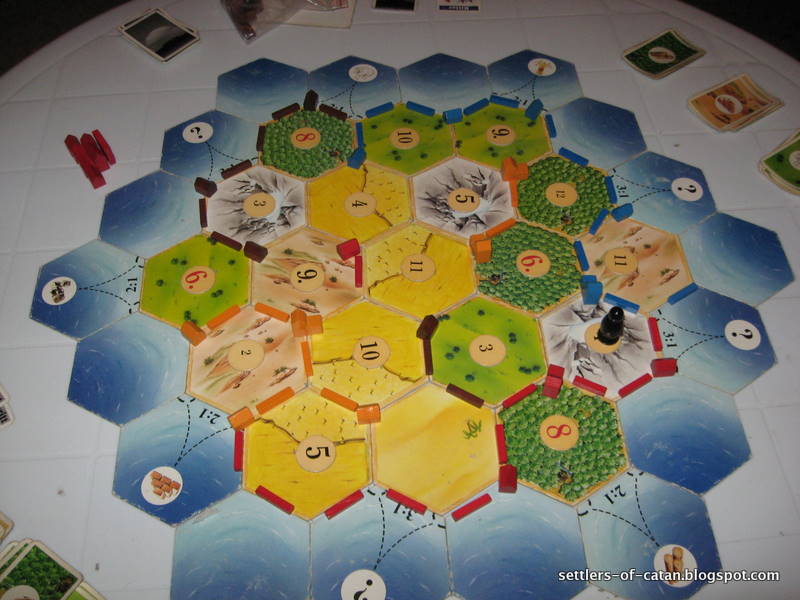
Then it was Daniel's turn. He studied the board.. and someone commented that, with the first six placements, we had totally blocked the central 11-wheat hex. In fact, by placing where we did, each building directly opposite another, we had actually managed to block every other inland intersection. The only remaining building spots were on the coast!


So Daniel took a spot with good ore - and the potential for 'coins' commodity cards - and Richard took a useful place with both sheep and wood:


Daniel and Becky did both have all five resources available, while I was lacking wheat and Richard lacked clay. 

Then, since we realised that resources were going to be thin in the ground, and we've had games where 11s seem to come constantly, we decided to use the Traders and Barbarians cards instead of rolling dice, so that we would, at least, get statistically likely numbers in proportion. 

As usual, we don't play the event die nor use 7s until at least two rounds have passed, and until at least two people have built something - we also play the 'friendly robber' scenario, meaning that the robber may not be put on a hex that is adjacent to any player with only two (or, in Cities and Knights, three) points. But a couple of 10s were turned over early in the game, so it wasn't long before Becky had expanded and built on the sheep harbour - something she hoped to use extensively - and I had also managed to build another settlement:


Richard and Daniel were stuck, and clay was a scarce resource at this stage, so nobody wanted to trade it. 

With limited building spots available, Becky and I both expanded as rapidly as we could, and it wasn't long before she had the longest street:


So she had eight points, and was in the lead. I had managed a second city by this stage, so was second with six points. Daniel and Richard each had four, still struggling for clay, but hadn't been able to build any cities yet, although a few knights were by now scattered around Catan. 

When we started rolling the event die, several of us had already made a few city improvements; I found that the books commodity was coming fairly often, and picked up some useful cards. Surprisingly quickly, I gained an extra two points with a metropolis on books: 


So Becky and I each had eight points. Daniel had gained a victory point for the most knights when the pirate ship landed for the first time, so he and Richard each had five points by this stage. 

I kept expanding, and - with the help of a useful street-building card - managed to gain the longest street card from Becky: 


So I had 12 points on the board, and nobody else was likely to take the street card from me. We play to 14 in Cities and Knights for more than two players, and I had picked up one victory point progress card - so I was one away from victory, and quite a long way ahead of everyone else. 

However, I forgot entirely that I should have activated my knight. I only had one, and was - as usual - leaving the proctetion of Catan to other players. But the pirate ship was fairly close to landing, and we didn't have enough activated knights. It was Richard's turn, and he had the cards to build another city. He didn't want to do so, not wanting to lose it... but then realised that, with a little trading, he could also buy and feed a knight, so he did that. 

Then it was Becky's turn, and she rolled the black event, so the pirate ship was just one move away from landing. She had a choice - she could activate her knights so as to protect Catan, and then gain a victory point through having the most active knights - or she could activate just one, meaning that I would be the player with the least active knights (ie zero!) and would lose a city. 

Becky decided to be kind, so she fed her knights. We were safe... 

... then Daniel, who didn't move the pirate ship on, built another city.  Catan was no longer safe.  My turn at last, and I would be able to activate my knight so long as I rolled one of the coloured events... 

.. but I didn't. I rolled a pirate ship event, and Catan was attacked. And I lost a city, and therefore a point:


So now I was back to 12. Richard, who had control of the merchant, had 8, Becky and Daniel each had 6. But it was only a matter of time. It did, at least, mean that we all had another turn, which enabled Becky to reach the metropolis on cloth, as well as another settlement and city, giving her 10 points by the end. 

I had too many cards by the time it was my turn again; had I lost half of them to the robber, we would probably have played yet another round. But as it was, I was able to re-build my lost city, giving me 13 points... and then I produced the progress card I had collected during the round which enabled me to take control of the merchant, and give me the final victory point I needed: 


So Becky and I were quite  a long way ahead of our menfolk. Possibly, as Daniel pointed out, this was (at least in part) due to the fact that they had been forced to place their initial cities on the coast, giving them fewer resources at the beginning. 

Sunday, 21 November 2010

Rivers of Catan (for two)

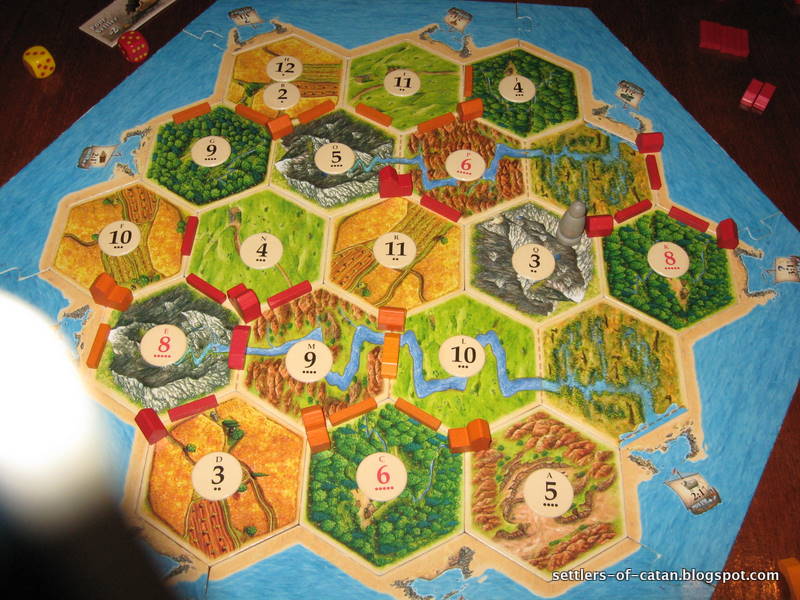
It's been a few months since we last played the 'Rivers of Catan' scenario from Traders and Barbarians. So we decided we'd try it again yesterday evening. The main differences in setup are the 'rivers' hexes which replace some of the regular ones, the 'swamps' which replace the desert, and the fact that the 2 and 12 numbers are put on the same hex.


During game-play, bridges can be built (for two clay and one wood) and coins can be earned by building roads or settlements next to the river. These coins can be traded for resources.

We decided to use the 'harbormaster' card in our game, but to use dice rather than Catan event cards. And although we weren't sure if there would be much point using the 'wealthy settler' and 'poor settler' card, we decided we might as well...

Then I forgot to take a photo after we'd placed our initial pieces. Here's the game after a few rounds:


I'd managed to upgrade one of my settlements to a city, and Richard had built another settlement on the coast. We'd built a few streets too.. and I had also built my first bridge:


In a two-person game there's usually plenty of room for expansion, so they tend to be fairly amicable. However, Richard really wanted the 8:3 ore:wheat coastal intersection, which I'd rather hoped for, so he took it in a single move:


We then noticed that I had the longest street. So that gave me 9 points in buildings, plus the other two, making 11. Except that I also had the 'poor Settler' card, which meant I needed an extra two points if I were to win. 18 rather than 16, in other words...

I had the clay harbour from my initial placement, and that had come in useful. I thought I might go for the wood harbour too, as I was getting quite a bit of wood... and Richard pipped me to the post.

So then I thought I'd go for the sheep harbour, as I had been collecting sheep... only to have Richard built streets to block me from that one too:


He was the first to reach three settlements on harbours, so took the Harbormaster card, and an extra two points.

So I had twelve points on the board and he had ten. We each had two extra points... but since he still held the 'wealthy settler' card, and I was the 'poor settler', he was in practice a point ahead of me rather than two behind.

I built my final settlement. I also extended my long street, so that it couldn't be overtaken. I had been buying development cards, and had played a couple of knights. So now I played my third knight, giving me the largest army:


So I had 17 points, which should have been enough to win... but I was still the 'poor Settler'. So I needed one more. Richard had 12 points on the board, plus the harbormaster, plus the 'wealthy settler' which gave him an extra point, so he also needed only one to win.

But my turn came first. I bought a couple more cards... and one of them was a victory point:

Saturday, 20 November 2010

Seafarers (fog island) - a longer game than necessary

Since I've stopped writing about every game of Settlers that we play, I've also stopped taking photos, in general, during the games. On Thursday, Richard and I decided to play a round of Seafarers of Catan with our favourite 'fog island' scenario. I didn't want anything too lengthy or mentally tiring, although I'd forgotten just how long it takes to set the game up!

It wasn't a very equal game, since Richard made a mistake on his initial setup, and I was able to build a great deal faster than he was. When I put my final settlement down, I realised - since I had the longest trade-route, and also a couple of hidden victory points, that I'd won since I had more than 16 points (which is what we play to when there are just two of us). Richard knew it too, but suggested another couple of rounds, out of interest. All I could do, basically, was buy development cards (which I did) and I also built my last two streets and ships, because I had the cards in my hand.

And then he said I should really take photos and write about the game...

By the time we finally finished (when the last hidden hex had been revealed) the table was looking quite a mess:


Although I won, Richard took and held onto the 'largest army' card. He had one of the biggest 'armies' I can remember seeing in a game:


However, I had an extremely long trade route, giving me the 'longest street' card without even having to count:


My 'army' consisted of four knights, and by the end I had three victory points (so I had a total of 18 points) - and several more development cards which I had bought but had not had a chance to play:


It wasn't until late in the game that Richard noticed that we'd taken the wrong bonus cards - I had taken the largest army and he had taken the longest street! Not that it mattered in the slighest, as each is worth two points, but we solemnly exchanged them so as to be correct.

I was getting tired by the end, and buying so many development cards that I just threw my resource cards on the table, leading to quite a muddle:


The game was unusual for a few reasons..

1) Despite us both regularly picking up handfuls of cards by the end, the robber was never able to steal from either of us. For once, 7s were only rolled when we had both managed to spend our resource cards, and only had a few in our hands.

2) The pirate ship was not moved at all, despite a normal number of 7s being rolled, in addition to all the knight cards shown above:


3) Although I built far more ships than I usually do (by the end I had built all my ships AND all my streets) the vast majority of hexes I 'discovered' were simply sea... and the desert:


Whereas Richard, with a very modest fleet of ships, discovered only one sea hex, while all his others were resource hexes:


It was a good game, full of laughter. It really didn't matter who won - it was inevitable that I was going to, early on, but part of the fun of this scenario is exploring the hidden hexes.

Wednesday, 17 November 2010

Fishermen of Catan and the Harbourmaster

We've played quite a few regular games of Settlers and Cities and Knights; I'm only writing about more unusual variants now. One of those happened on Monday, when we pulled out our 'Traders and Barbarians' expansion, and decided to start at the beginning again. There are several interesting sets of pieces within the box, and variations on the Catan theme which can be used with or without other expansions.

The first scenario in the booklet is the one called Fishermen of Catan. There are fish tiles laid around the outside, and a 'lake' hex replaces the desert:


The little pile of blue next to the resource cards are the little fish tiles, which may have one, two or three fish on them, and which can be traded in various ways. I described this in some detail when writing about our first game of Fishermen of Catan.

We used dice rather than the event cards, but we did decide to bring in the 'harbo(u)rmaster' card which functions like the Longest Street or Largest Army. As soon as any player has three or more harbours - of any kind - that player receives the Harbourmaster card, and two extra victory points. It can then be taken by another player who gains more harbours later on:


Since there were just two of us playing (Richard red, me orange, as usual) we started with three initial settlements each. We don't play the two-player version described in the Traders and Barbarians box (although we should probably try it some time) but our own two-player house rules, although we vary those from time to time too.


As can be seen, we each took an intersection by the lake, which produces fish any time 2, 3, 11 or 12 is rolled. Other than that, we took fairly predictable spots. Richard took one on the coast, with a fish ground tile nearby (which would give him a fish any time a 5 was rolled) but I kept mine inland.

I decided to head, first, for the 3:1 harbour which was by the 6-fish tile, and built my first settlement there:


So that would give me a fish piece every time a 6 was rolled.

Richard headed for a couple of fish tiles on the coast, too, but I decided to build my second settlement on the 8-ore hex:


I decided, next, to head for the other end of my 6-fish tile, and the wood harbour. In my hand, I had a wood, a clay, and a wheat resource (and a couple of ore, which weren't relevant). I also had five hidden fish tiles, which added up to 9 fish. I knew I could trade four of them for any resource of my choice.. so was going to put down the street I could buy from my hand and perhaps buy another wood and clay. Then realised that I needed to think more strategically. With five fish tiles, I could place a free street, leaving my wood and clay resources towards my settlement. Then I could use the other four fish to buy the sheep I was lacking, and place the settlement immediately:


Obvious, I know. But we were just getting used to these extra pieces and it wasn't always easy to think straight!

We'd both built all our settlements, in a fairly even way, and had to start building cities. For some reason, that wasn't so easy, and it was good that we had the fish to enable us to buy extra resources. Richard remained one point ahead of me for the first half of the game:


He then joined up two sections of streets, so took the Longest Street card and two extra points. He then picked up the 'old boot' tile, which nestles amongst the fish tiles... which meant that he would need one extra point to win the game. He could give it to 'any player' with as many or more points than he had - but since he had more than me, he couldn't give it away...


I built out to the sheep harbour, which gave me three harbours and thus the Harbormaster card - and two more points.


The extra settlement meant that I now had nine points on the board, the same as Richard, and we each had a card giving us an extra two. Naturally, I didn't point this out (when I noticed) since I didn't want to be handed the old boot...

Play continued as ever, with resources being gathered faster than ever, although I don't think either of us was caught out by the robber. We play to 16 points; we'd reached the stage where I had built all my cities and settlements - giving me 13 points on the board - and Richard had built all of his other than one settlement, so he had 12 on the board. I still held the Harbourmaster card, and he still held the Longest Street card. Neither of had bought many development cards, but Richard had played two knights, so it was likely that he would gain the Largest Army before long...

.. so, when I managed to collect several wood tiles, and a pile of fish, I decided to spend them on streets to link up my two road sections, and thus took the Longest Street card:


So I had 17 points, winning the game, and Richard was back to 12. Even if he had given me the old boot, it wouldn't have been a problem as I had the extra point.

Thursday, 14 October 2010

Settlers of Catan... via Skype!

I decided a few weeks ago that I would stop writing about every single Catan game we play, and only include new posts when there are variations (such as those in 'Traders and Barbarians') or other unusual features.

One such very unusual feature - indeed, unique from our perspective - occurred on Tuesday evening, when we were chatting online to our son Tim, who is a student in the UK. We live in Cyprus. Tim was feeling a bit bored and made an idle comment about how he wished we could play Settlers over Skype. Immediately, I wondered if it would be possible. Would the quality of my webcam be good enough...? So we set up a board, out of curiosity, and put Richard's laptop on the sofa, where we could see Tim:


Then we set up my little portable webcam on a chair, pointed at the Settlers board:


And Tim could see it quite clearly enough!


Of course, it was quite absurd to suggest actually playing a game. And yet... it looked rather a nice layout. And we had half an hour before Richard needed to go out, and Tim needed to eat. So we thought we might just try a bit of a game to see if it was possible. And since Tim wanted to see us as well as the board, Richard set up the internal webcam on his computer to point at us, via yahoo chat. We were probably at our maximum bandwidth...

Tim had to go and fetch resource cards from the set in his house, and we were all set. We chose three fairly distinct colours that were easily distinguishable via the webcam. I had my usual orange, Richard opted for white rather than his usual red, and Tim took blue. We rolled our dice, Tim used a random dice generator on his computer when it was his turn. I went first and placed my settlement, then it was Tim's turn - since we were playing clockwise - and he told me where he wanted his one to go. With the second settlements, he took the cards from his set of resources.


Then we played our first few moves. It must have felt a bit odd to Tim, but I was surprised how oddly 'normal' it felt to be playing a board game - a physical board game - with someone a couple of thousand miles away.


Trading resources with Tim was easy enough. We agreed the relevant exchange, then each traded with our own 'bank' of cards, as if trading with each other.

We had to think for a moment when Richard wanted to place the robber on one of Tim's hexes and steal a card from him. But it wasn't a problem. Tim held his cards up to the screen, so Richard could choose:


.. and when Richard decided which one he wanted, I closed my eyes, Tim showed Richard what the card was, and discarded it himself, while Richard took the relevant card from the bank. I didn't take many photos of the board; I was too interested in the game and the technology. We did take a break when Richard and Tim had to depart, temporarily, but then resumed an hour later.

Tim was in the lead for a while, then I took the longest street card and had eleven points. However, Tim took it from me fairly quickly:


- he then built another city, which put him in the lead with ten points, while I was back to nine:


Richard, who set it all up technologically, wasn't doing so well in this game.

Tim built another city, and so did I. Then I built another settlement, too. So we both had eleven points:


Oddly enough, very few development cards had been bought in this game.** Partly, I suppose, because ore was a relatively rare resource, so when any of us had any, we used it to build cities. Even at this stage, clearly near the end, I had bought - and played - one knight card, and that was all.

My turn came round. I could trade my cards to built another settlement, and I had a building spot, which meant that I could win... except that I didn't have any settlements left to play. I needed a city first, but could not gather the resources for that. And since I didn't want to be caught by the robber, I opted to buy my second development card of the game.

It was a victory point.

And so, although I had rather hoped Tim would win, I was the first with 12 points.


**If Tim had wanted to buy a development card - which didn't happen - we would have picked up the top card, and put it under the webcam (without looking at it ourselves) so that he could see what it was, and then take the equivalent card from his own set. We would then have replaced our card at the bottom of the deck.

Sunday, 19 September 2010

Settlers of Catan for four

Another Thursday evening. Another game with the four of us. Sheila brown, Jörn blue, Richard red, me orange.

It wasn't a particularly inspiring layout for the board. It looked as though there was going to be an over-abundance of wood, a fair amount of sheep, and not a whole lot of anything else. Nor where there any obviously brilliant starting spots.

Sheila went first and took the 3-6-9 with ore, sheep and clay. It's where I'd have gone in first place, too. Probably the best place for numbers, certainly the best spot for clay which was likely to be the scarcest resource of all.

Jörn went second, and took the 4-8-10, with wheat, with wheat, wood and sheep. Equally good numbers, technically, but no clay or ore. I was third. Already there were no attractive spaces to take, so I followed the strategy of taking the best possible ore spot, which was on a 5. It bordered a 6-wood which I hoped would be useful, and also an 11-wheat, which was less likely to be of value.

Richard was last; quite a useful situation for this unhelpful board. He was able to get access to all five resources, and five different numbers: 3, 4 (twice), 8, 9 and 11. I now needed clay and sheep, but the only place to get both was on the coast, with a 2 on the clay, which didn't seem very useful. So, as I usually sacrifice sheep (so to speak!) if one resource must go, I looked at the options for clay. There was really only one possibility: the final place on the 9-clay hex, which bordered a 10-wheat that I hoped would be useful, and also the 2-clay. So that's what I took.

Jörn needed clay and ore, so he took a reasonable spot which gave him both, even though the clay was on an 11; it also gave him an 8 on wood... and made it unlikely that Richard would be able to take the nearby 3:1 harbour.

I then took a photo, not realising that Sheila hadn't placed her second settlement. She suggested I post it anyway, and ask readers where they might have placed the second brown settlement...


Sheila pondered two or three options. She needed both wheat and wood, but couldn't possibly take both. She had considered one of the 8-wood hexes, but one possible spot bordered only the desert, and the other bordered only the 3-ore hex which she had access to already; she was tempted by it, since it would have given her an instant 3:1 harbour, but it looked as if she might have been boxed in rather rapidly, with very few - if any - building spots.

So, as wood was evidently going to be plentiful, Sheila opted for the 3-10-11 intersection which gave her two wheat hexes, and five different numbers altogether.


Play started quite slowly, except that 11s were rolled more often than would be expected, and 10s not at all in the first few rounds. Jörn and Richard were both easily able to build streets, and I went as rapidly as I could to the intersection with two wheat hexes which would give me a five. Richard built in the spot where Sheila had hoped to go, which meant that her building spots were rather limited anyway, and he was first to gain the longest street card, but Jörn soon extended his street further and took it away.


So Jörn had five points, as did I; Richard had four, and Sheila had three.

With my extra wheat and reasonable ore (5s were rolled pretty much as expected statistically), I was fairly quickly able to build another city. I did have to give up cards to the robber more than once; but I found myself with wood and sheep all too often, and nothing I could do with them. It then occurred to me that I should probably take the wood harbour; I hadn't thought of it as a useful building spot, since I already had two settlements on the 2-clay hex, and one on the 5-wheat. But with the amount of wood I was collecting, it was definitely worthwhile.

So I took it - just before Richard planned to. He kept extending his street in the hope of taking back the longest street card. He did for a few rounds, but then Jörn took it back again, and we realised that he was now unbeatable as far as that went.

I then built another city, made almost entirely of 2:1 traded wood.


So Jörn had eight points at this stage, and I had nine. We each had one remaining building spot, although my last one was also Sheila's last one, and she was struggling to do anything so I didn't plan to take it, even though she urged me to! I had already played two knights - being in the lead, I was frequently the target of the robber - and needed only one more to gain the largest army. I also knew I could fairly easily build one more city, so I didn't actually need another settlement.

And that's what happened. If Jörn had had a hidden victory point card, he would have won, but he didn't. So when my turn came around, I built my last city, and played my third knight:

Saturday, 11 September 2010

Four-person Settlers of Catan game in the evening

Looking back at the scoring lists we keep, I was a little surprised to discover that the last time Richard and I played a four-person Settlers game with just Jörn and Sheila was back in May. We've loved having so many other people to play Catan games with, of course, but sometimes it's good to have just the four of us who played so many games together last year.

We set the board up outside, for the first time this year. And, since I'm writing this four days after the game happened, I've forgotten who started. I think it may have been Jörn (with blue pieces, as usual). If so, then he opted for the six-wheat hex as one of his starting ones since wheat looked as if it might be in short supply. if he was first, Sheila was second (brown), and took one of the 8-4-3 intersections which I had been looking at. I (orange) then took the other. Richard, who (I think) was last (red) began with good numbers (5, 9, 10) - the best selection of numbers available - on wood and two clay.

It was quite a nice board, and we all managed to begin the game with a reasonable selection of resources and numbers. Richard lacked wheat by the end, while Sheila and I each had only 11 on wheat. But nobody was obviously in a much better position than anyone else:


The first few moves were fairly predictable, and also reasonably amicable. Jörn and Richard both headed towards the coast, and the relevant harbours. Richard did build an extra street to protect the wood harbour from Sheila; so she went the other way towards a 3:1. I decided to head for an inland spot first; not particularly useful in theory (3 on sheep, 11 on wheat, and the desert...) but I could see that inland spots were going to be at a premium, due to the layout of our initial settlements. I did have a faint hope that I might be able to build out quickly towards the 5-wheat/10-ore hex, but suspected that Jörn would get there first...


...which, indeed, he did. Sheila headed to the other side of that nice 5-wheat hex, so I concentrated my building around the coast near the 8-ore hex I'd taken at the start. Richard hoped to get there too, and we did compete for the spot which eventually I took - but since he'd built an extra street it was still possible for him to get a spot around the edge of that 8-ore hex.

Oddly enough, 11 was rolled rather often in this game, so it wasn't long before I was able to build my first city.


So Sheila and I each had five points, Richard had four, and Jörn had three.

I decided, next, to head towards the coast at the bottom of the board in the hope of being able to get a 9 hex. Sheila, meanwhile, gained the longest street card. Richard and Sheila each built a city, but Jörn was having a hard time getting the resources he needed, and was still stuck on three points:


So Sheila was well in the lead with eight, while Richard and I each had six.

Building spots were fast becoming scarce, but Jörn had good supplies of both ore and wheat, so was able to build some cities - and as he did so, naturally gained more frequent resources which he could trade as needed. In quite a short space of time he went from three to eight points. I managed to get my coastal hex including the 9-clay, and Richard took the sheep harbour, which I did also consider. It could have been decidedly useful. Sheila extended her longest street to ensure that nobody else could take it - not that there were really any possible contenders by this stage.

Sheila and I had each played two knight cards, but she was first to play a third and thus gain the largest army:


So she now had ten points. Jörn had jumped to second place with eight, while Richard and I each had seven.

We now concentrated on building cities and buying development cards, while hoping not to be caught by the robber with more than seven resource cards. We reached the stage where Sheila had eleven points and I had nine... and then I played a fourth knight, and took the 'largest army' card from her. So now I had eleven, and she had nine.

I had one more city to build, and although nobody would trade with me, I managed it anyway and thus scraped another win:


But it was all very close. Richard and Sheila each had ten points, and Jörn had nine.

Catan: Explorers and Pirates (first game, scenario 1)

Our usual default Catan game is Cities and Knights. It was quite a steep learning curve before we could relax into it, but now we can chat ...