Thursday, 22 December 2011

A most efficient layout on a six-person Catan game

A few weeks ago, we were playing a six-person Settlers of Catan game, with our usual friends and one friend's parents. A six-player game can, of course, lead to rather an over-crowded board, but as we progressed through the game, it seemed that nobody had run out of building spots early on.

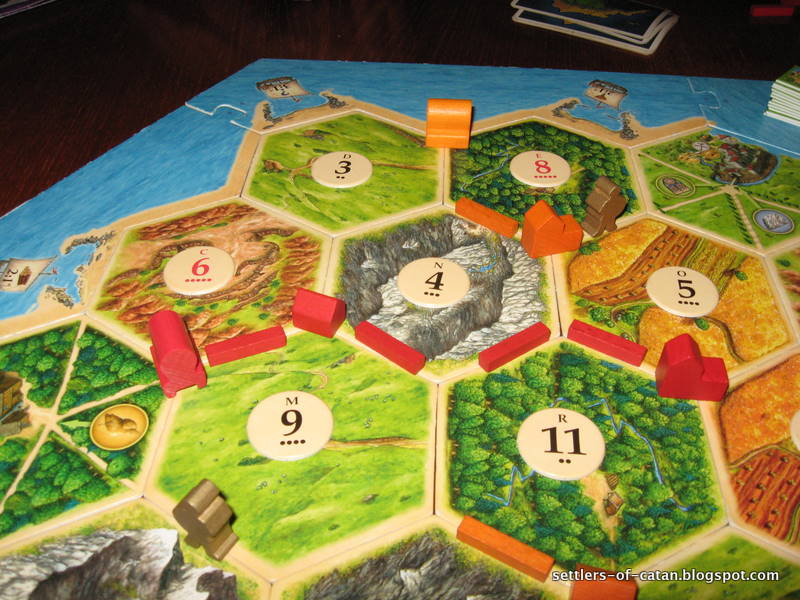
It wasn't until about half-way through that I suddenly realised what a remarkably efficient layout we had managed to produce:


Quite by accident, none of our settlements was directly opposite another on any hex. So, theoretically, we had the maximum possible number of building spots. Blue, green and orange had all run out of new spots by this stage, but each had managed six. Red had six already, and one more. And there were four remaining spots which could be accessed by either white or brown.

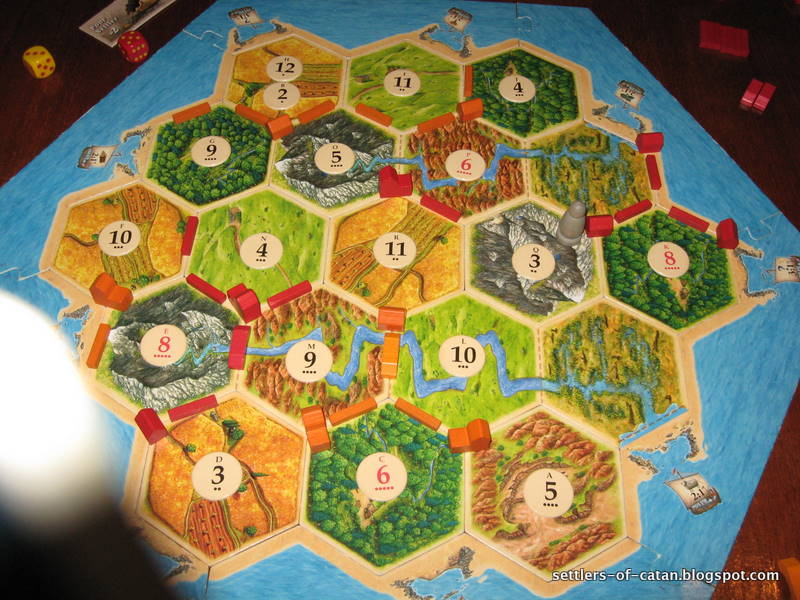
As it happened, the game did not continue for many more rounds after that. Here's the final board:


I think it was Richard (red) who won, with the largest army (or perhaps two victory points) as well as ten points on the board.

Friday, 30 September 2011

Cities and Knights of Catan for two

An evening to ourselves, and another two-person Cities and Knights game using our normal two-player Catan house rules. I've stopped photographing and writing about every single game - there were just far too many - but the layout of the board looked rather interesting, with resources rather clumped together, so I thought it was about time I logged another game.

As this picture shows, all the wood was together in the middle; all the clay was together at one edge, and all the ore was also together. It made initial placements quite tricky:


I had most numbers, but was lacking a six, and my clay was apparently going to be rather limited. Richard lacked only 2, 11 and 12 number-wise, and looked as if he was going to do pretty well with city improvements using cloth.

We always play a few round before bringing the robber (and third die) into play, and with plentiful ore and wheat, we both built cities, rather bravely given that we also needed sufficient knights to defend them, once the pirate ship started sailing towards Catan.

Oddly enough, the 10 was rolled rather more often than would be expected, giving us both enough clay to fortify cities against the robber... it was wood that was lacking. We had both managed one street and one new settlement by this stage of the game; I was particularly pleased to have built on a 6, as I had originally planned.

But there was only one knight (mine)... and the pirate ship was rapidly approaching....


... happily, non-black 'events' on the third die came up a few times, enabling me to upgrade my knight, and Richard to buy and feed a two-strength knight, so by the time the pirates landed, Catan was safe. No victory points awarded, but we each picked up a progress card of our choice (inevitably they were both green ones).

.. and the knights were de-activated. It looked as if it was going to be a slow-moving game...


City resources were coming in thick and fast, due to our well-placed cities, but not much else had happened by the time the second pirate attack happened - just a few more streets, an extra settlement for Richard, and some more knights - basically bought because the relevant resources kept arriving and we didn't want our hands too big.

I hadn't activated any knights other than my double one, so Richard won the victory point for the next pirate attack:


And, once again, black events were rolled fairly often. All that happened before the third pirate attack was that a couple more settlements were built, and Richard managed a metropolis (with cloth, unsurprisingly)) which would probably have led to his winning the game, but for one thing: I picked up the card which allowed me to exchange any two of the numbers on the board, other than the 2, 12, 6 or 8. So I changed the 5 on clay (which Richard had) with the 11 on wood, which I had.

This time, I had the most active knights and won the victory point:


Richard was well ahead, though. He had 11 points on the board, including the metropolis, one victory point from a progress card, and one victory of Catan point. I had only 8 points on the board, plus my newly one victory of Catan card.

Then suddenly the action hotted up. I claimed the longest street card... only to have it snatched from my grasp when Richard took it from me. A mistake on his part, as it turned out, because it meant that he did not consolidate his cloth metropolis, and I was able to take it from him (permanently):


Our scores were now very even. Not that we tend to notice while playing.. .sometimes one of us has won several rounds before either of us notices.

The action continued - Richard built a wood metropolis, and I built a couple more streets, thus getting the longest street card back again, at least for a turn or two...


So I had 12 points on the board, the longest street card, and one victory point. 15 in all. Richard had 12 on the board, and one victory point. Unusually, the merchant had not yet come into play.

Then I played the merchant, giving me an extra point. I built another settlement, and another city, and gained the third metropolis too, all in one round...


... which gave me 20 points, and thus a fairly resounding victory, which I had not expected given how far Richard was ahead in the early stages of the game. However, there's a fair amount of luck, and I happened to be lucky with the rolls of the dice.

Thursday, 25 August 2011

Settlers of Catan with very few building spots!

Last night, for the first time in a while, we played a four-person Settlers game with our friends Jörn and Sheila.

After our initial setup, Sheila spotted that the central 11-sheep hex was entirely inaccessible. None of us could remember seeing that kind of scenario before - but with six settlements arranged around the middle 'circle' of hexes, there were no spots at all available to be used on the central one.

I didn't think to take a photograph until we were fairly well into the game, when we realised that that, with only 18 cities or settlements, we had actually run out of building spots entirely:


Sheila, playing brown, had the longest street and so was well in the lead at this stage, with 10 points and five buildings; Richard (red) was second with 6 points; he also had managed five building spots. Jörn (blue) and I (orange) had only managed to grab four building spots each, and were tied in bottom place with five points. While it's possible to win with only four building spots, it's not easy. I prefer at least five. I did wonder whether I could get the 'largest army' but with sheep in fairly poor supply, it was difficult to buy many cards.

Strangely enough, as we upgraded our settlements as far as we could, 11s and 4s were rolled more than would be expected, and at one point I was able to 'monopolise' sheep, gaining 13 of them. With no harbours I had to trade rather heavily, but it did at least enable me to upgrade to another city and buy a further card.

I did get a victory point, and two knights.. but Jörn got in with a third knight first, and the largest army. Richard took the longest street from Sheila - and built sufficient roads that it could not be taken back - and suddenly our scores were more even: at one point we were on 9, 8, 7 and 6 points. Theoretically it could have been anyone's game, except that eventually there was nothing to do other than buy cards.

It was Sheila who won in the end, playing a fourth knight and thus taking the largest army, as well as producing two victory point cards. So she won with 13 points. Richard was second with 10, I had 9 (including my victory point), and Jörn was back to 6.


Friday, 8 July 2011

Three-person Settlers of Catan game

We've played many games in the past eight months, but this blog was getting a bit tedious... so I left it for a while.

On Tuesday afternoon our son Tim arrived, very tired and decidedly out of practice with Settlers of Catan. But he suggested a three-person game anyway. It was a nice board. We all started with a wide selection of numbers, and either four or five resources. Tim and Richard soon took a couple of useful harbours, and it all seemed quite even, although I was lagging behind. However I managed to take the longest street card, pushing me up to 8 points, only one behind Tim and Richard who were each on 9. I vaguely thought that play would continue for a while, and that any of us could have won. I was the only person who had played any knights, so I thought I might take the longest army in a turn or two...

Then Tim's turn came round. He had sufficient cards to build more streets, and take the longest street from me. And then revealed that he had THREE victory points:


Apparently he could have won in his previous turn (with 12 points) but hadn't remembered that he could declare victory points immediately they were bought. He only bought three cards in all. And it wasn't as if all the victory points were at the top of the pack since I had bought knights in between his cards. And it had been well shuffled.

So the final score was: 14 to Tim, 9 to Richard, 6 to me.

Monday, 29 November 2010

Traders and Barbarians of Catan

Last night, we decided to play another Traders and Barbarians scenario. Richard thought we might as well do the last one - the game that's actually called 'Traders and Barbarians'. It took ages to set up. The story is that the barbarians have, basically, been conquered but there are still a small number to be found along lonely streets of Catan. Buildings have to be re-built, and islanders need to use their wagons to transport relevant commodities to the correct places.

Here's an overview of the initial board:


There's no desert, and no robber. A couple of hexes have been removed too (one sheep, one wheat) and there are three new trading hexes which supply the commodities. The 2 and 12 numbers have been removed - if those are rolled, the person simply rolls again.

There are, however, three barbarians on the board. Rather confusingly, the instructions said that we needed all thirty of them, so Richard also got out the knights. But in fact we didn't need any other than the initial three.

In addition to our regular pieces, we each had a wagon:


And some cards to show us how far we could move the wagon each turn:


- which all seemed remarkably confusing when we read the instructions, but did gradually make sense as the game progressed. We each started with four 'moving points' per turn. The wagons have to be moved along intersections. If they move along one with a street in place, it costs one moving point. If there is no street, two moving points. And if there's a barbarian on the street, then it costs an extra couple of moving points.

However, if the street belongs to another player, then that player has to be paid a gold piece. We should each have started the game with five gold pieces but didn't notice that instruction. Gold is also earned for delivering resources via the wagons.

Here's a close-up of the first of the trading hexes:


Tools have to be delivered there; sand or quartz can be collected from it.

Here's the second:


Sand has to be delivered there; tools or glass can be collected from it.

And here's the third, the castle:


Glass and quartz have to be delivered there; tools or sand can be collected.

Roads can be built to the centre plaza area of these trading hexes, but no settlements can be built on them. Roads cannot be built on their borders with the sea.

So... here is our initial placement. Since there were just two of us playing, we put down three initial buildings - and since the final one has to be a city (which is where the wagons are also placed to start with) we did what we do in the Cities and Knights games: two settlements and one city each.

I was completely bewildered by the new regulations, so just chose my spots as I would for a regular game. The instructions did say that it's important to build plenty of roads so as to allow more rapid movement of wagons, so I made sure of reasonable wood and clay. The 'longest street' card is not in play.


Richard quickly built some streets, and moved his wagon along four of them, using up four movement points. I could not move mine so far as I only had one street at the time. Although it would have been quicker to go past the barbarian... The aim is to reach one of the trading hexes as soon as possible to collect one's first trading commodities - however I was more concerned about building some more settlements to start with.


Still, one can move the wagon every turn in addition to building; Richard got first to one of the trading hexes, and picked up his commodity, and set out for the place he had to deliver it to. Meanwhile I bought a settlement and a city. But I finally got to the first plaza and picked up a commodity card, which had 'tools' on it.


Richard upgraded his movement cards a few times... I didn't think about it until I'd done some more building, then realised that the cards remaining in my hand were exactly what I needed to get to upgrade:


So now I had five movements points per turn, and collected two gold pieces rather than one for each successful delivery.


I could also now take an extra chance if my wagon landed next to a barbarian. I could roll one die, and if a 6 was rolled, could move the barbarian. Further upgrades to the cards give more chances to move the barbarian.

I'd been taking so many pictures of individual parts of the game (the last two forgetting the close-up setting, so they're a bit burned out and not properly focussed) that I'd forgotten about the whole board. But this was the state of play of the game by this stage:


I had nine points in buildings, having had a lot of ore and wheat, and thus built all my possible cities already. Richard had five. What we hadn't realised (I hadn't read the full instructions yet) was that for every successful commodity delivery, we should have had an extra victory point. We did wonder why the instructions said to play to 13 points (regular games of Settlers are 10) and wondered where extra points would come from. Of course, just building all the cities and settlements makes 13 points, and we usually play to 16 in a two-person game (18 with Cities and Knights) but were wondering where extra points might come from.

It wasn't long before I had streets that went, pretty much, from the castle hex to the one nearest me. And I kept on picking up tools from the castle, quartz from the other one... which meant I would have been raking in commodity points if we'd realised we were supposed to get points.


Richard had to travel along my streets from time to time, so I got a fair amount of gold for that. And two pieces of gold can be used, up to twice per turn, to buy an individual resource card. Which was extremely useful at times.. so I kept on building. And the more I built, the more resources Ikept picking up. I did, once, have to give up six cards when a 7 was rolled (although the robber is not in play, the barbarians can steal cards in the same way, but do get moved by whoever rolls the 7).

Sheep were in rather short supply in this game, and were needed for most of the movement card upgrades, so we realised that, until pretty near the end, neither of us had bought any development cards. There's a special pack of 25 that go with this scenario, but they cost the same as in a regular Settlers game.

It's possible for two wagons to be in the same place at the same time, as happened in one of the plazas:


- by which stage I had 12 points in buildings, and Richard had 8. If we'd been counting commodity delivery points, we probably each had about the same number of those.

So I built my last settlement. Then figured all I could do was keep on transporting commodities, and spending resources on development cards. The first one I bought gave me an extra wagon journey, which was quite useful.

The second one I bought was a victory point. So Richard said he thought that made me the winner, and that we should stop:

Sunday, 21 November 2010

Rivers of Catan (for two)

It's been a few months since we last played the 'Rivers of Catan' scenario from Traders and Barbarians. So we decided we'd try it again yesterday evening. The main differences in setup are the 'rivers' hexes which replace some of the regular ones, the 'swamps' which replace the desert, and the fact that the 2 and 12 numbers are put on the same hex.


During game-play, bridges can be built (for two clay and one wood) and coins can be earned by building roads or settlements next to the river. These coins can be traded for resources.

We decided to use the 'harbormaster' card in our game, but to use dice rather than Catan event cards. And although we weren't sure if there would be much point using the 'wealthy settler' and 'poor settler' card, we decided we might as well...

Then I forgot to take a photo after we'd placed our initial pieces. Here's the game after a few rounds:


I'd managed to upgrade one of my settlements to a city, and Richard had built another settlement on the coast. We'd built a few streets too.. and I had also built my first bridge:


In a two-person game there's usually plenty of room for expansion, so they tend to be fairly amicable. However, Richard really wanted the 8:3 ore:wheat coastal intersection, which I'd rather hoped for, so he took it in a single move:


We then noticed that I had the longest street. So that gave me 9 points in buildings, plus the other two, making 11. Except that I also had the 'poor Settler' card, which meant I needed an extra two points if I were to win. 18 rather than 16, in other words...

I had the clay harbour from my initial placement, and that had come in useful. I thought I might go for the wood harbour too, as I was getting quite a bit of wood... and Richard pipped me to the post.

So then I thought I'd go for the sheep harbour, as I had been collecting sheep... only to have Richard built streets to block me from that one too:


He was the first to reach three settlements on harbours, so took the Harbormaster card, and an extra two points.

So I had twelve points on the board and he had ten. We each had two extra points... but since he still held the 'wealthy settler' card, and I was the 'poor settler', he was in practice a point ahead of me rather than two behind.

I built my final settlement. I also extended my long street, so that it couldn't be overtaken. I had been buying development cards, and had played a couple of knights. So now I played my third knight, giving me the largest army:


So I had 17 points, which should have been enough to win... but I was still the 'poor Settler'. So I needed one more. Richard had 12 points on the board, plus the harbormaster, plus the 'wealthy settler' which gave him an extra point, so he also needed only one to win.

But my turn came first. I bought a couple more cards... and one of them was a victory point:

Saturday, 20 November 2010

Seafarers (fog island) - a longer game than necessary

Since I've stopped writing about every game of Settlers that we play, I've also stopped taking photos, in general, during the games. On Thursday, Richard and I decided to play a round of Seafarers of Catan with our favourite 'fog island' scenario. I didn't want anything too lengthy or mentally tiring, although I'd forgotten just how long it takes to set the game up!

It wasn't a very equal game, since Richard made a mistake on his initial setup, and I was able to build a great deal faster than he was. When I put my final settlement down, I realised - since I had the longest trade-route, and also a couple of hidden victory points, that I'd won since I had more than 16 points (which is what we play to when there are just two of us). Richard knew it too, but suggested another couple of rounds, out of interest. All I could do, basically, was buy development cards (which I did) and I also built my last two streets and ships, because I had the cards in my hand.

And then he said I should really take photos and write about the game...

By the time we finally finished (when the last hidden hex had been revealed) the table was looking quite a mess:


Although I won, Richard took and held onto the 'largest army' card. He had one of the biggest 'armies' I can remember seeing in a game:


However, I had an extremely long trade route, giving me the 'longest street' card without even having to count:


My 'army' consisted of four knights, and by the end I had three victory points (so I had a total of 18 points) - and several more development cards which I had bought but had not had a chance to play:


It wasn't until late in the game that Richard noticed that we'd taken the wrong bonus cards - I had taken the largest army and he had taken the longest street! Not that it mattered in the slighest, as each is worth two points, but we solemnly exchanged them so as to be correct.

I was getting tired by the end, and buying so many development cards that I just threw my resource cards on the table, leading to quite a muddle:


The game was unusual for a few reasons..

1) Despite us both regularly picking up handfuls of cards by the end, the robber was never able to steal from either of us. For once, 7s were only rolled when we had both managed to spend our resource cards, and only had a few in our hands.

2) The pirate ship was not moved at all, despite a normal number of 7s being rolled, in addition to all the knight cards shown above:


3) Although I built far more ships than I usually do (by the end I had built all my ships AND all my streets) the vast majority of hexes I 'discovered' were simply sea... and the desert:


Whereas Richard, with a very modest fleet of ships, discovered only one sea hex, while all his others were resource hexes:


It was a good game, full of laughter. It really didn't matter who won - it was inevitable that I was going to, early on, but part of the fun of this scenario is exploring the hidden hexes.

Wednesday, 17 November 2010

Fishermen of Catan and the Harbourmaster

We've played quite a few regular games of Settlers and Cities and Knights; I'm only writing about more unusual variants now. One of those happened on Monday, when we pulled out our 'Traders and Barbarians' expansion, and decided to start at the beginning again. There are several interesting sets of pieces within the box, and variations on the Catan theme which can be used with or without other expansions.

The first scenario in the booklet is the one called Fishermen of Catan. There are fish tiles laid around the outside, and a 'lake' hex replaces the desert:


The little pile of blue next to the resource cards are the little fish tiles, which may have one, two or three fish on them, and which can be traded in various ways. I described this in some detail when writing about our first game of Fishermen of Catan.

We used dice rather than the event cards, but we did decide to bring in the 'harbo(u)rmaster' card which functions like the Longest Street or Largest Army. As soon as any player has three or more harbours - of any kind - that player receives the Harbourmaster card, and two extra victory points. It can then be taken by another player who gains more harbours later on:


Since there were just two of us playing (Richard red, me orange, as usual) we started with three initial settlements each. We don't play the two-player version described in the Traders and Barbarians box (although we should probably try it some time) but our own two-player house rules, although we vary those from time to time too.


As can be seen, we each took an intersection by the lake, which produces fish any time 2, 3, 11 or 12 is rolled. Other than that, we took fairly predictable spots. Richard took one on the coast, with a fish ground tile nearby (which would give him a fish any time a 5 was rolled) but I kept mine inland.

I decided to head, first, for the 3:1 harbour which was by the 6-fish tile, and built my first settlement there:


So that would give me a fish piece every time a 6 was rolled.

Richard headed for a couple of fish tiles on the coast, too, but I decided to build my second settlement on the 8-ore hex:


I decided, next, to head for the other end of my 6-fish tile, and the wood harbour. In my hand, I had a wood, a clay, and a wheat resource (and a couple of ore, which weren't relevant). I also had five hidden fish tiles, which added up to 9 fish. I knew I could trade four of them for any resource of my choice.. so was going to put down the street I could buy from my hand and perhaps buy another wood and clay. Then realised that I needed to think more strategically. With five fish tiles, I could place a free street, leaving my wood and clay resources towards my settlement. Then I could use the other four fish to buy the sheep I was lacking, and place the settlement immediately:


Obvious, I know. But we were just getting used to these extra pieces and it wasn't always easy to think straight!

We'd both built all our settlements, in a fairly even way, and had to start building cities. For some reason, that wasn't so easy, and it was good that we had the fish to enable us to buy extra resources. Richard remained one point ahead of me for the first half of the game:


He then joined up two sections of streets, so took the Longest Street card and two extra points. He then picked up the 'old boot' tile, which nestles amongst the fish tiles... which meant that he would need one extra point to win the game. He could give it to 'any player' with as many or more points than he had - but since he had more than me, he couldn't give it away...


I built out to the sheep harbour, which gave me three harbours and thus the Harbormaster card - and two more points.


The extra settlement meant that I now had nine points on the board, the same as Richard, and we each had a card giving us an extra two. Naturally, I didn't point this out (when I noticed) since I didn't want to be handed the old boot...

Play continued as ever, with resources being gathered faster than ever, although I don't think either of us was caught out by the robber. We play to 16 points; we'd reached the stage where I had built all my cities and settlements - giving me 13 points on the board - and Richard had built all of his other than one settlement, so he had 12 on the board. I still held the Harbourmaster card, and he still held the Longest Street card. Neither of had bought many development cards, but Richard had played two knights, so it was likely that he would gain the Largest Army before long...

.. so, when I managed to collect several wood tiles, and a pile of fish, I decided to spend them on streets to link up my two road sections, and thus took the Longest Street card:


So I had 17 points, winning the game, and Richard was back to 12. Even if he had given me the old boot, it wouldn't have been a problem as I had the extra point.

Catan: Explorers and Pirates (first game, scenario 1)

Our usual default Catan game is Cities and Knights. It was quite a steep learning curve before we could relax into it, but now we can chat ...